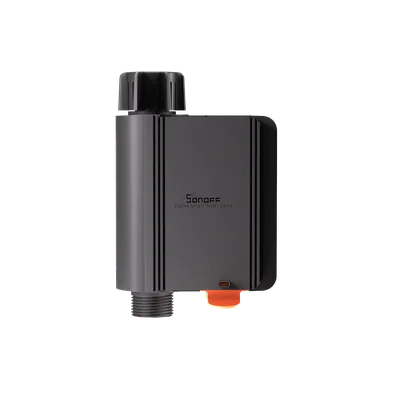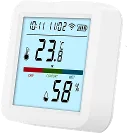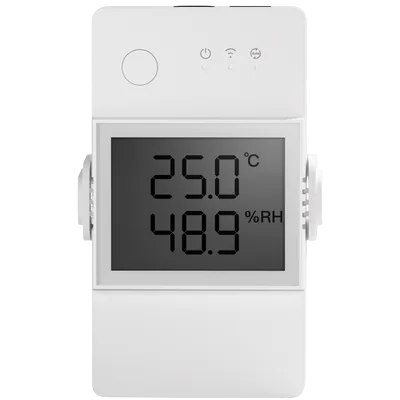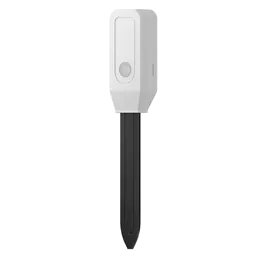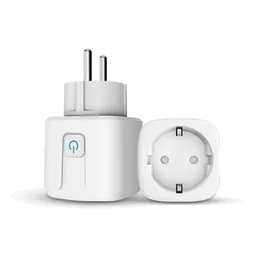

Tuya / Smart LifePlugs · sensors · IR air conditioning · CO₂Design unconventional light cycles, automate irrigation and climate, and turn every grow into research you can measure, understand, and share.
Better in the app · alerts, photos and real-time control
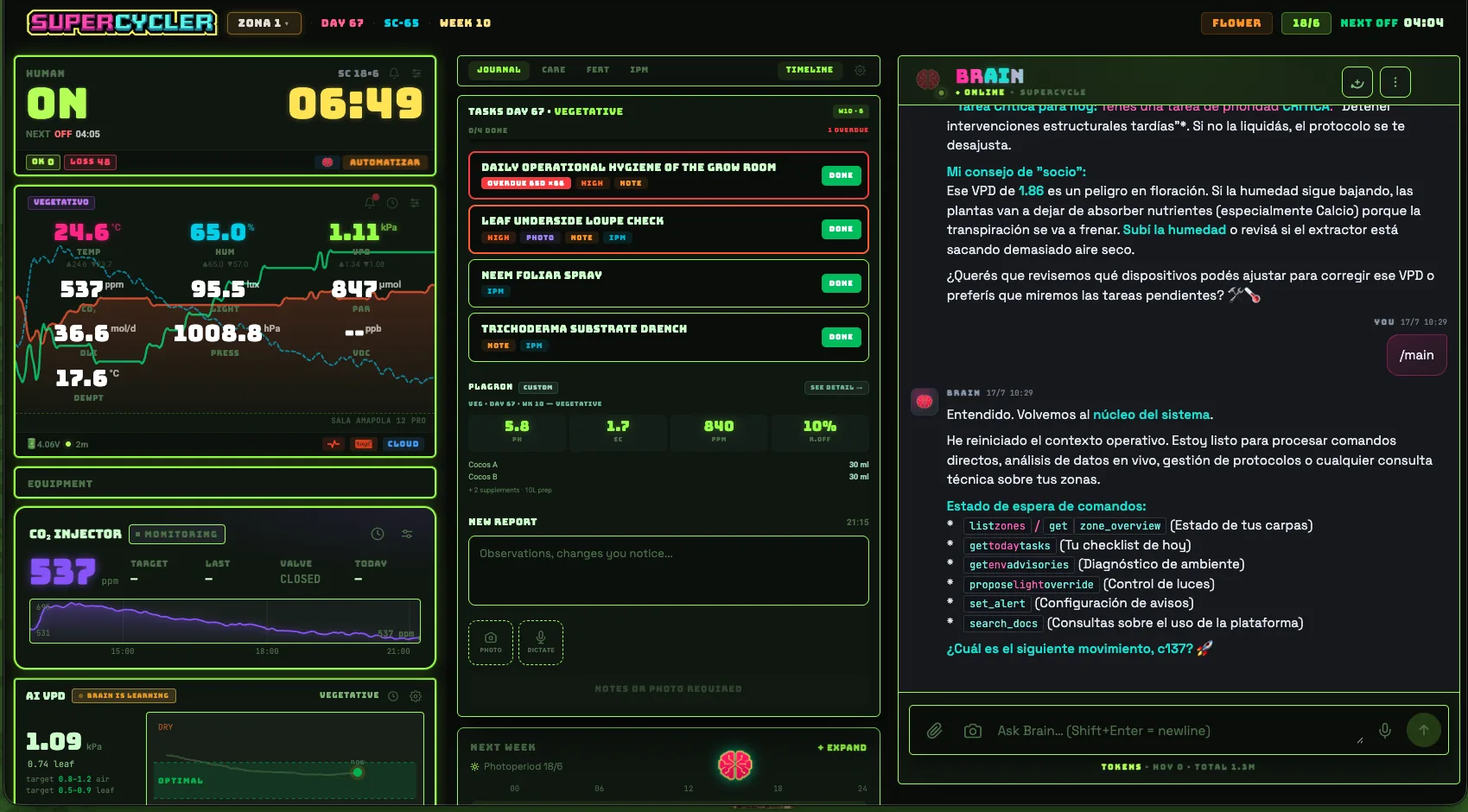
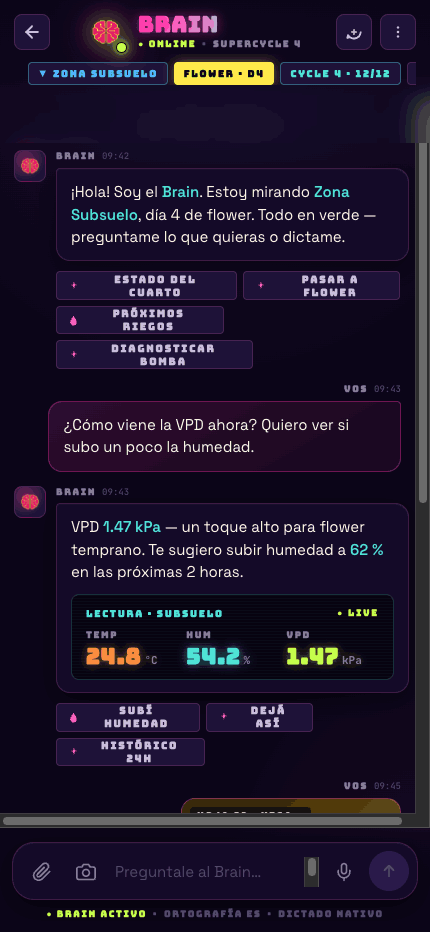
Supercycler acts on the physical world of your grow. And it doesn't do so as a black box.
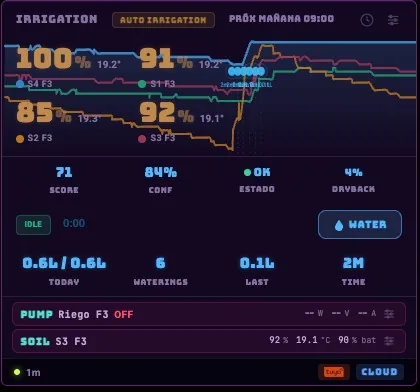
Manual, scheduled, light-synchronized, moisture-based, pulse, volume-based, and Crop Steering.
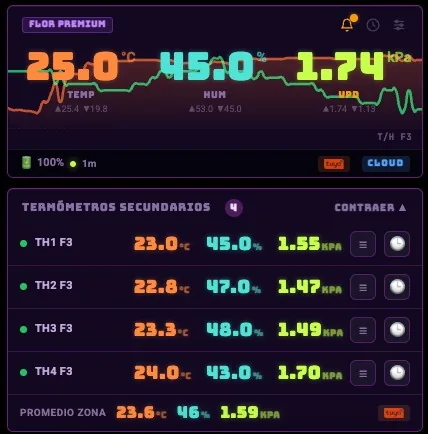
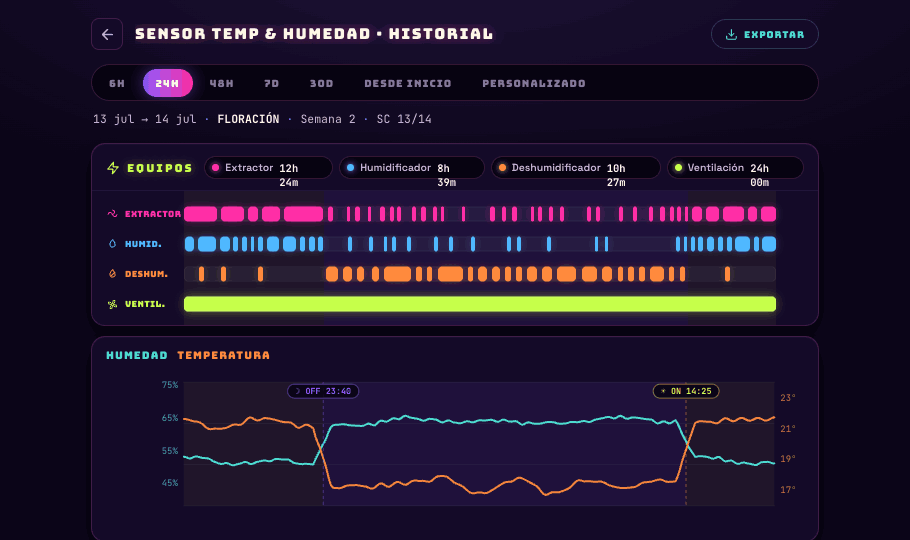
Temperature, humidity, VPD, and CO₂ are evaluated continuously, with hysteresis and safe states.
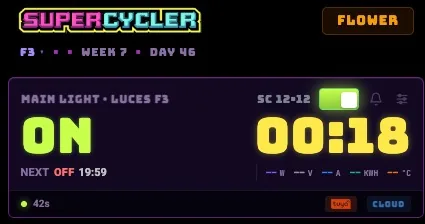
Photoperiod guardian and auto-healing. You see the real state of the light, how long it has been that way and when the next change is due.
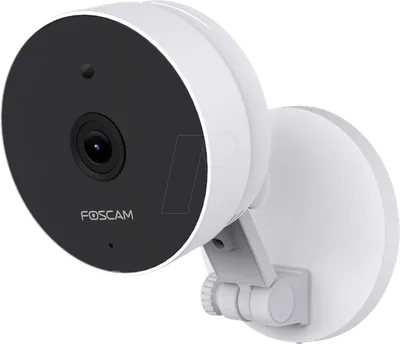
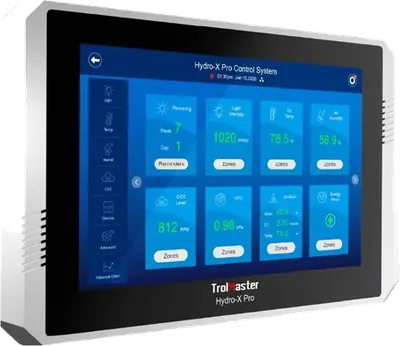
Bring controllers, sensors and instruments together in your zones. Search for your brand and see what each integration can do.

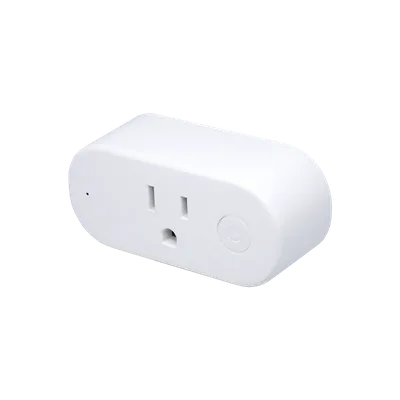
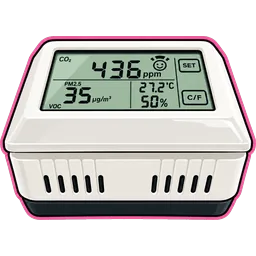
Tuya / Smart LifePlugs · sensors · IR air conditioning · CO₂
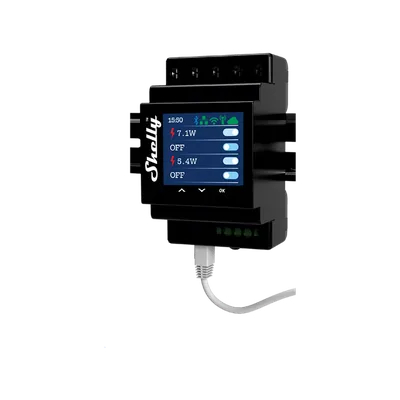
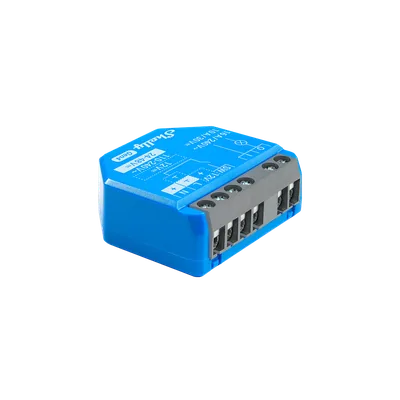
ShellyPro 4PM · Plus 1PM · Plug · BLU H&T

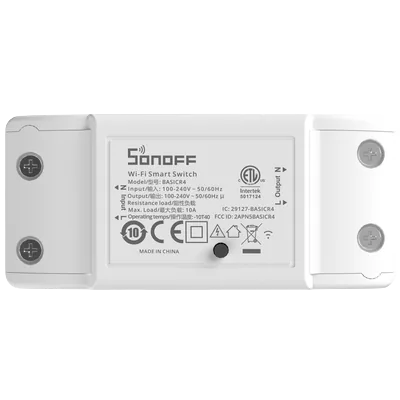
Sonoff / eWeLinkBASIC · MINI · POW · TH Elite


DIY / ESP32Brain ESP32 · MQTT · reference firmware
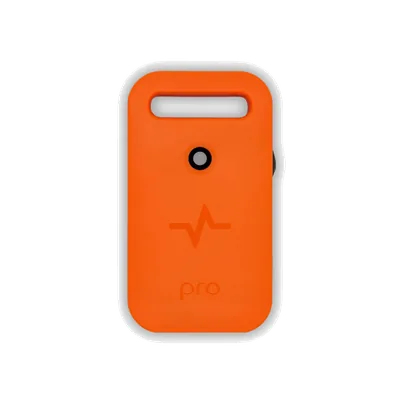
PulsePro · Zero · One
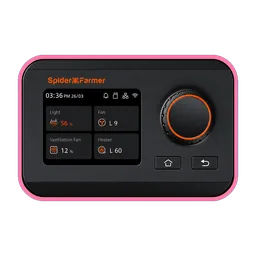
Spider FarmerSF-GGS-CB
Home AssistantSensors over MQTT · HACS integration
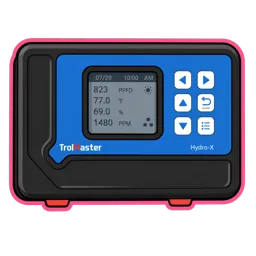
TrolMasterTCS-1 · HCS-1 · NFS-1
EcowittEnvironment and substrate sensors
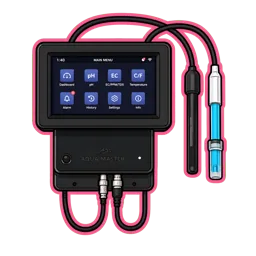
Aqua MasterC800
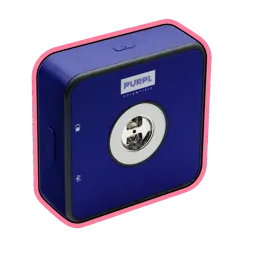
Purpl ScientificPurpl Pro
BluelabGuardian Monitor
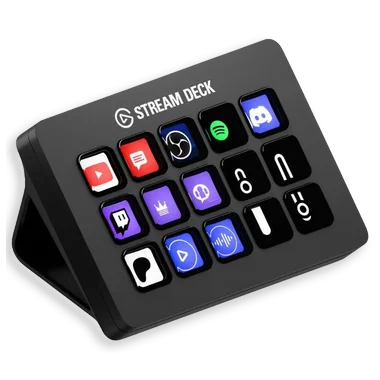
Stream DeckElgato · Supercycler pluginWe couldn’t find that brand or model. New integrations are added based on what the community asks for.
Capabilities depend on the model and its integration. Each card says what it does today.
The cycle stops being a fixed setting. It becomes a hypothesis you can run, observe, and compare.
You don't have to choose between growing and experimenting. You can run 12/12, share your data and be part of a global research effort out to create the first Supercannabis. Or you can go further and try a supercycle.
Every protocol turns a goal into a guided experience: it tells you what to do, how to do it, why it matters, what to watch for and how to log what happened. Pick a guide, apply it to your zone and get every step at the right moment; Brain is right there with you and it all stays in the Timeline.
Growing shouldn't depend on remembering everything. A protocol turns a growing goal into a sequence you run, review and improve.
By goal, by experience and by the phase your grow is in. You can start with the simplest one.
The protocol is assigned to a specific zone and knows what day, week and stage that grow is in.
They spread themselves by day, week and frequency: once, weekly, every 3 days, 2× a week or daily.
You complete it, answer with text, attach photos, dictate a note. Some tasks ask for specific evidence.
It explains what the task means, why it shows up now and what to look at before moving on. With your zone's context.
Every task, photo, note and decision is anchored to the exact moment of the grow. Searchable, not lost.
You don't have to know everything today. You only have to know what to do now. The catalog grows with you.
Less memory. Less guessing. More continuity from one day to the next.
Protocols isn't a single recipe. It's a catalog organised by intent: flowering, clones, mothers, irrigation, moisture, structure, supercycles, breeding and hydro.
A technique doesn't replace the guide: it adds its own tasks on top of the protocol you already have applied. Rooms, on the other hand, are complete zone protocols.
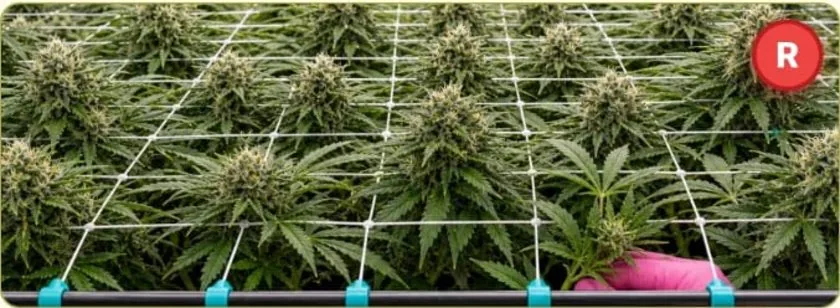
Flat canopy and even light: the net levels the tips so every bud gets the same light. Adds tucking, weekly levelling and density control.
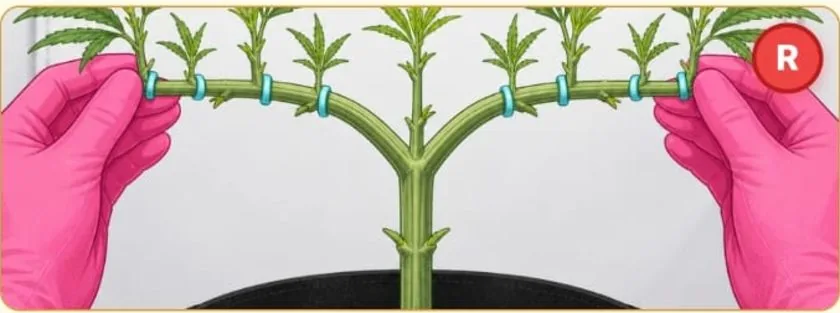
Symmetric architecture from veg on: a central manifold with equal arms, at the same height and with the same number of nodes.

A fortnightly technique for cutting clones from established mothers: from prepping the bench and sterilising to setting the clone in a jiffy or rockwool cube.
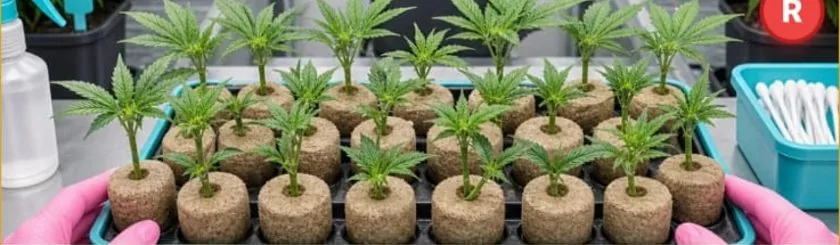
The grow's gene bank: preserving, maintaining and evaluating elite lines. Vigour, stability and continuity, not yield.
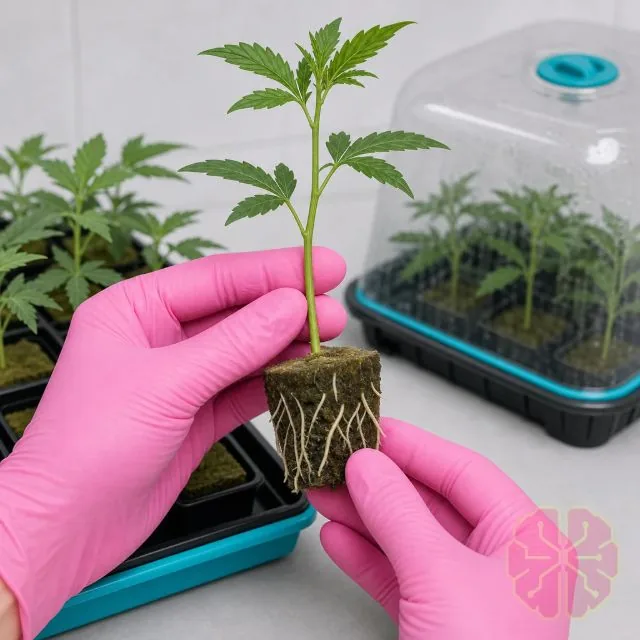
Cut → healing → callus → root → hardening off. The focus is survival, hydration and root quality before transplant.
Every protocol declares its phase, its task count and its environmental targets. The wide ranges of an Easy protocol tighten on their own once the zone has a VPD, CO₂ or PAR sensor.
Advanced protocols aren't mandatory. You can start with a simple guide and move up when your curiosity takes you further.
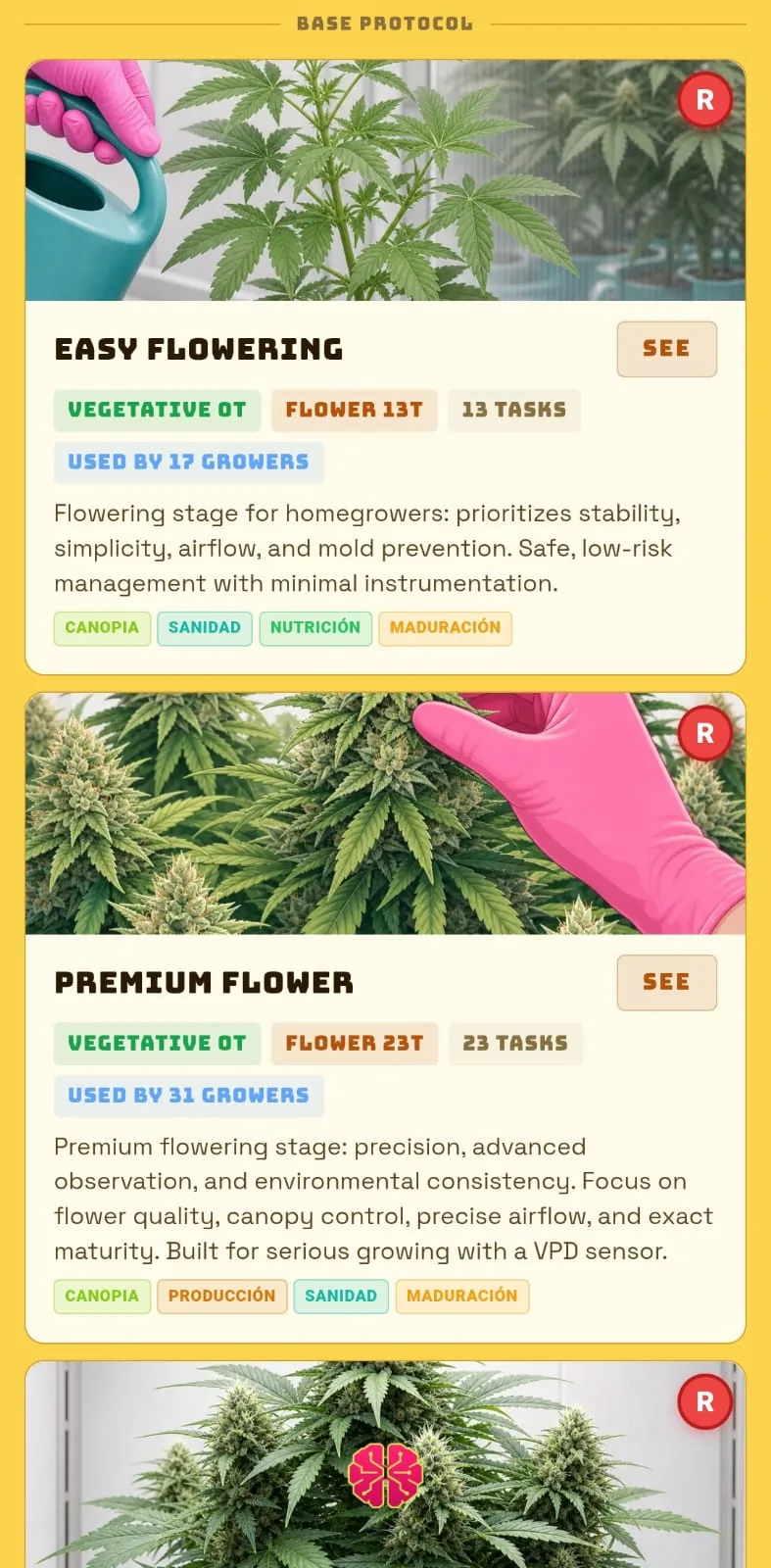
Real screenshot · the base protocol catalog with phase, task count and real usage.
Every task has a frequency and a window of weeks. The engine spreads them across your zone's real cycle: drag the flowering length and watch the whole schedule redistribute.
Tap any day in the grid to see what the protocol asks for at that point in the cycle.
A daily task generates 63 entries in 9 weeks. A weekly one, 9. The schedule isn't a list: it's a distribution.
We don't hand you a list to read. We hand you the next step to do: what to do, when, why it matters, what evidence is expected and what to do if something doesn't add up.
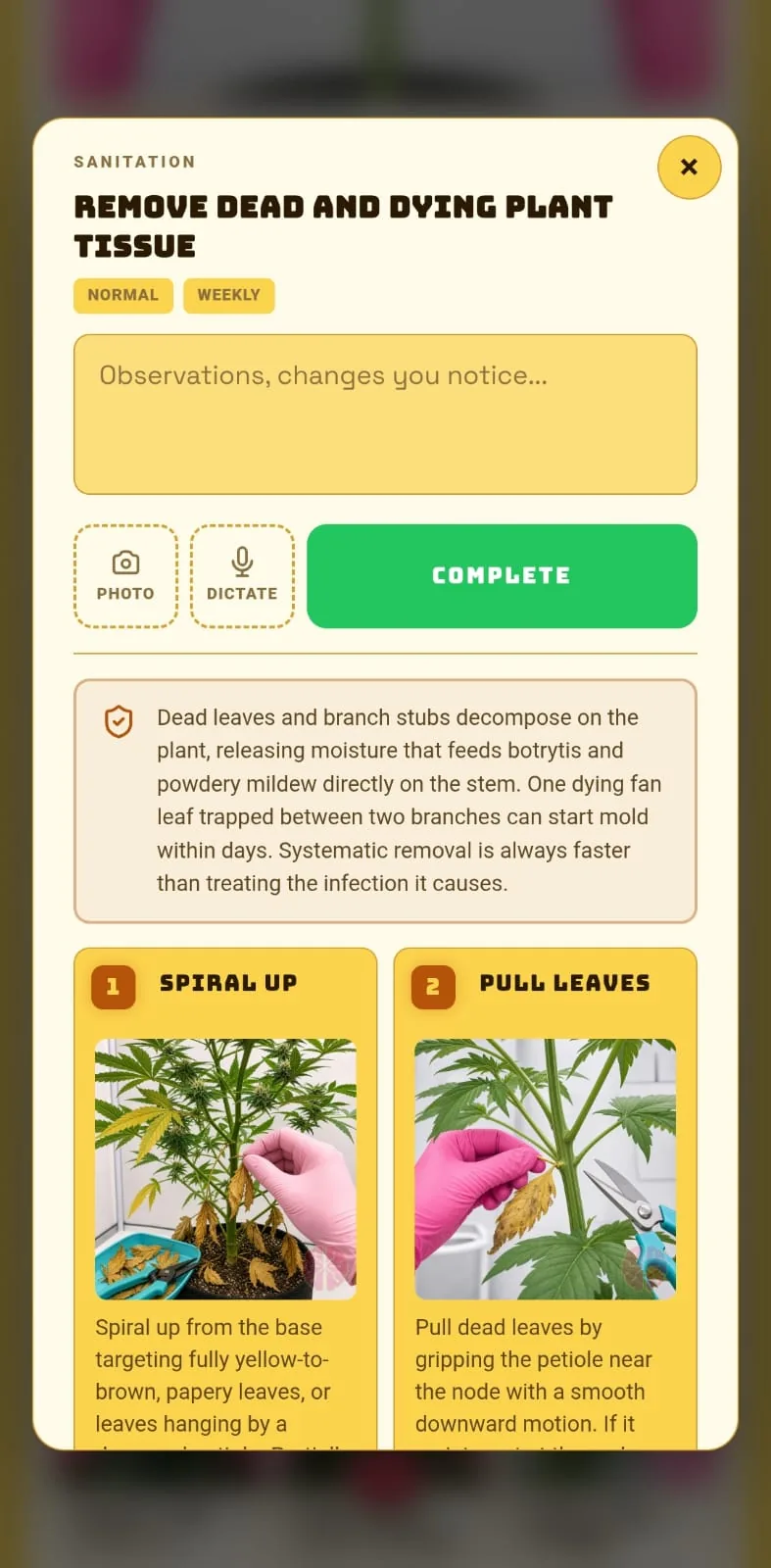
Real screenshot · the task opened in the app: evidence, Brain's context and illustrated steps.
Tasks can ask for specific evidence: a photo, a written note or the record of a treatment applied. Priority orders the day: critical first, high next.
Brain explains the task before you do it and reviews what you logged. It doesn't replace your own observation and it doesn't promise a biological outcome.
Completing a task isn't just ticking a box. The evidence stays connected to the day, the phase, the task and the rest of the grow: a story you can go back and read.
The Timeline gathers completed and pending tasks, photos, notes, environmental readings, protocol changes, light and irrigation events, human interventions and Brain's explanations.
Looking back stops being a memory exercise. You can answer what was done, when, what was observed, what Brain recommended, what changed afterwards and what's worth repeating or fixing.
What is a completed task today is reusable knowledge tomorrow.
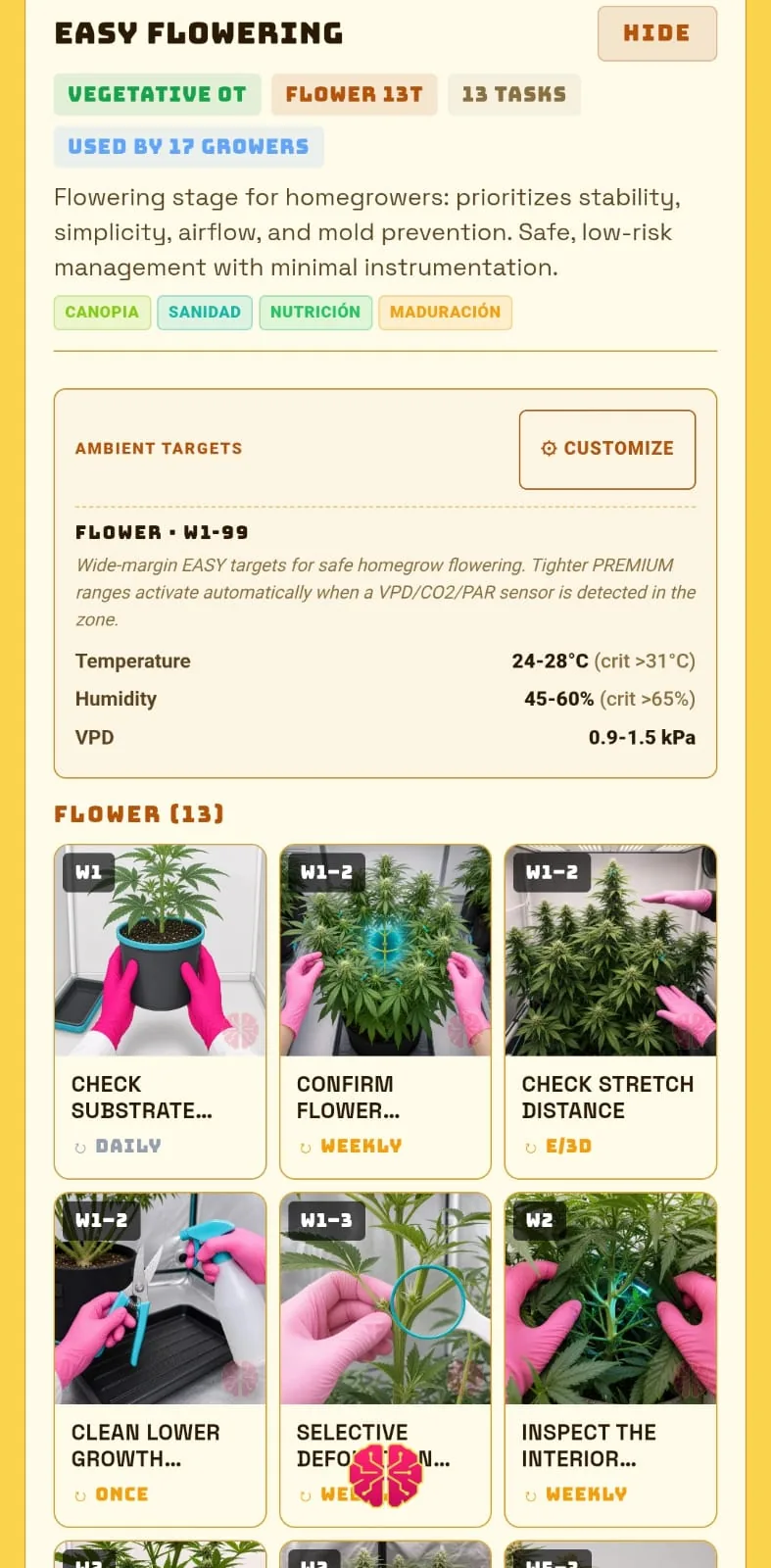
Real screenshot · the protocol's environmental targets and its 13 tasks placed by week (W1, W1-2, W2…) with their frequency.
Brain works with the context of that zone, that phase and that history. It explains why a task shows up now, what to observe before doing it and what changed since the last check.
Brain guides and keeps you company. The observing and the deciding stay yours.
Brain · zone contextPick a question to see how it answers using the grow's context.
Brain
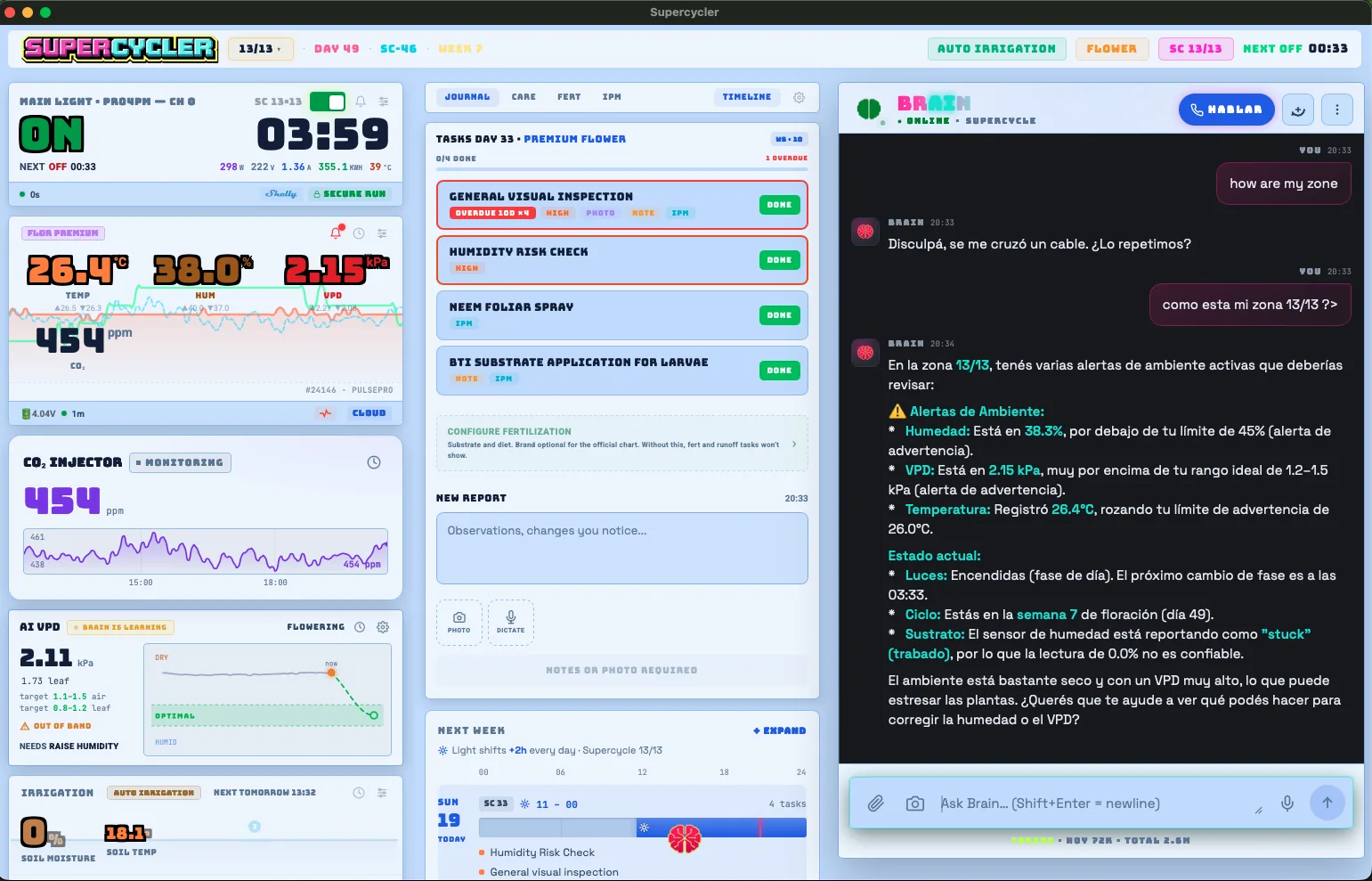
No generic chatbot. It answers with real numbers from your zone, clear explanations, and a suggested action. It can also speak first, review protocols, narrate events, and support you by voice.

Plant Scan · Beta
Scan a leaf and Brain analyzes it for pests, fungi, and deficiencies, then returns a diagnosis with confidence level, evidence, and an action plan. It's in open training. Every scan you make and every correction you add helps improve it.
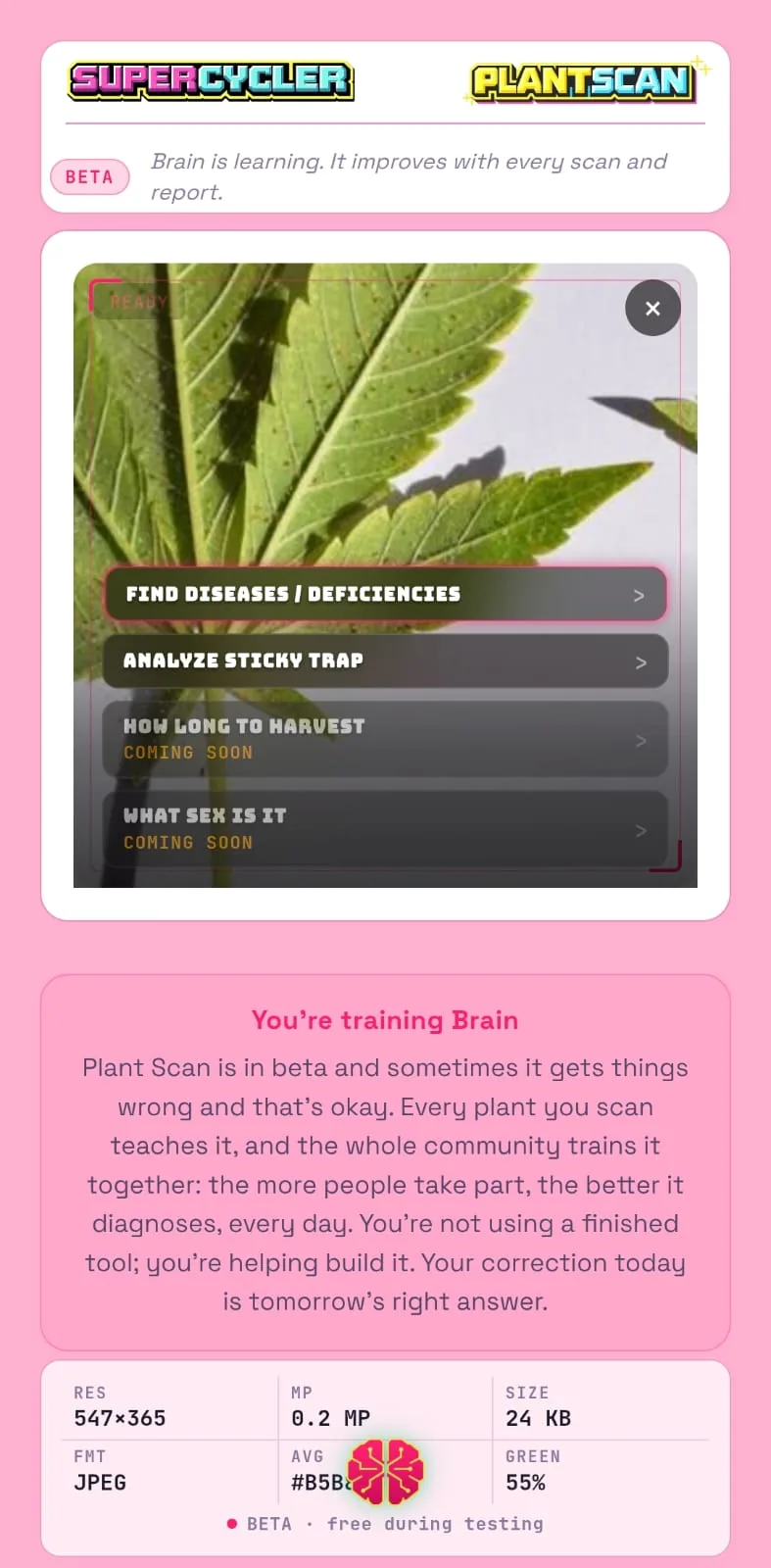
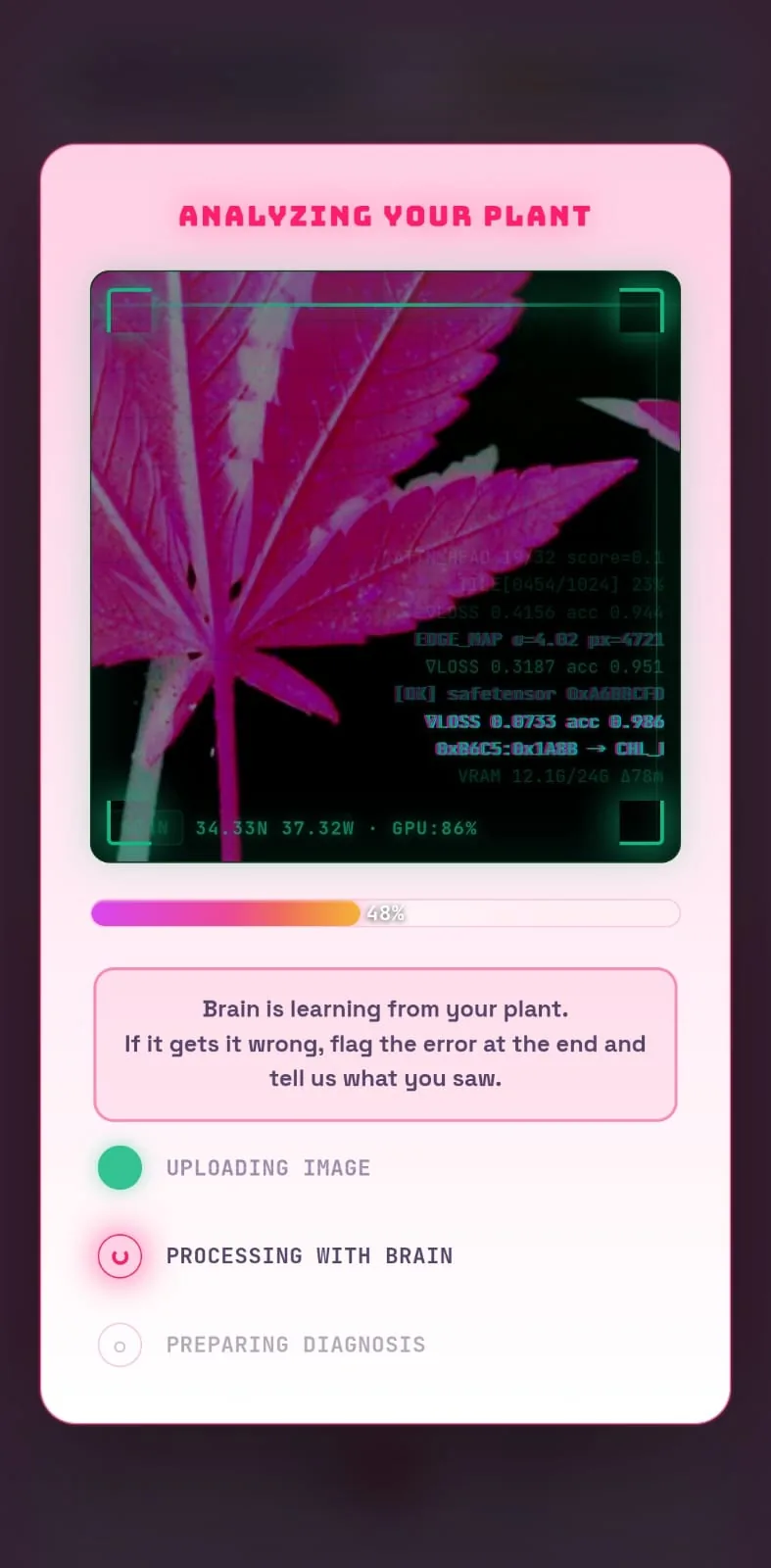
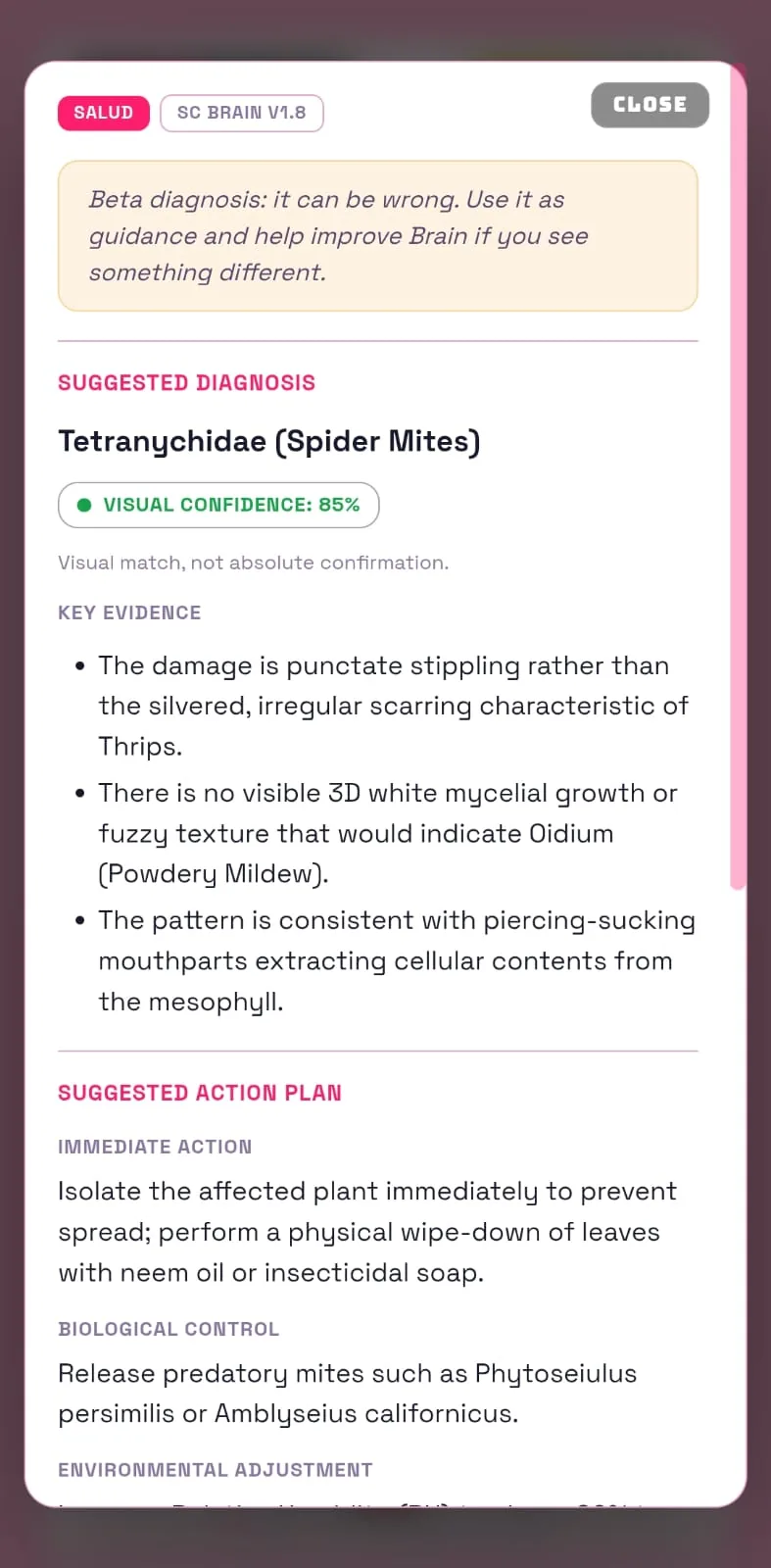
Plant Scan is in beta and sometimes gets it wrong, and that's okay. It's not a finished tool. You're building it with the whole community. If the diagnosis is wrong, flag the error and tell us what you saw. Your correction today is tomorrow's right answer.
A supercycle is a light and dark cycle whose total duration is not 24 hours. The trial evaluates whether a period longer than 24 hours changes the plant's development when every other condition is held constant. The design compares four periods, of 24, 26, 27 and 28 hours, and the main hypothesis proposes that a period close to 27 hours could match the endogenous circadian rhythm of Cannabis sativa.
The protocol, the predictions and the evaluation criteria are published before the trial closes. The results will be added to this page with their date, their method and their context.
Four cubicles, four genetics cloned and repeated across all four, and a different period in each cubicle. The only thing that changes between rooms is the length of the cycle.
The switch to flower, day 1, happened on September 1, 2026. The predictions were logged on August 16, before setup and with no data taken.
The four cubicles on one screen, one frame every five minutes since day 1 of flower. It updates once a week.
Set up on August 17, 2026. Switch to flower, day 1, on September 1, 2026. Harvest is per plant, once the maturity criterion is reached, and the prior expectation puts it between early and mid November.
Four arms, 12/12, 13/13, 13/14 and 14/14, with one cubicle each. Four genetics, with one clone of each genetic in every arm, and a container of chrysanthemums per arm as an exploratory observation.
Four identical 1 × 1 × 2 m cubicles, one per arm, white on the inside and with forced air exchange. One 300 W fixture per cubicle, four plants in 10 litre pots and a container of chrysanthemums in the middle. Between cubicles, only the length of the cycle changes.
Dry flower weight per plant on reaching the declared maturity criterion, which is read on the trichomes of a fixed spot. Harvest dates differ between arms and the days to harvest are analyzed as a variable. PAR measurement is still pending.
The trial compares four arms at a single site. These are the cycles published by independent growers, each with its genetic, its regime and its report code. They are analyzed separately from the controlled comparison and reported with their context.
Growers on the Supercycler network logged light and dark cycles longer than 24 hours, in different rooms and with different genetics. Those observations were used to define the variables and the contrasts of the current trial.
| Cycle | Period | Reported observation |
|---|---|---|
| 13/13 | 26 h | More flower and more resin than 12/12 in several reports, along with more calendar days to harvest. |
| 13/14 | 27 h | Calendar duration similar to 12/12 in several reports, with observed differences in the number of flower sites. |
| 15/17 | 32 h | Variable responses depending on the genetic, with morphological changes in most reports and unaltered flowering in some. |
| 16/16 | 32 h | Larger flowers in some genetics under the reported conditions. Same period as 15/17 and more hours of light. |
One thing that guided the design is that the 13/14 arm accumulates fewer hours of light per calendar day than 12/12. It is 11.56 h against 12, around 3.7% less, along with 3.7% more hours of darkness. If a higher dry weight were still observed, the explanation would not lie in the amount of light received but in what the plant does with the carbon it has already fixed.
The reports come from different rooms, operators and genetics, with no paired comparison arm. They let us decide which variables to measure in a controlled design, and they do not let us attribute an effect.
Beyond the main trial, the network gathers reports from independent growers. As of August 16, 2026 there were 113 active zones on 13/13 cycles, 22 on 13/14 and 132 on 12/12, and the protocol explorer listed 32 reports, 36 genetics, 11 cycles and 3 regions. The figures are kept with their cutoff date and updated with a new date.
These records describe the range of conditions under which the cycles are run and make it possible to formulate new questions. They do not replace a controlled comparison, because protocols, rooms and genetics differ from one report to the next. Each set is analysed and presented with its own level of evidence.
The hypothesis proposes that the endogenous period of the circadian clock of Cannabis sativa may lie close to 27 hours. If that relationship exists, an external cycle of 27 hours could produce a response different from the one observed with a 24-hour cycle.
A cycle whose total length is not 24 hours makes it possible to change the duration of light and of darkness separately. Under a 24-hour day the two are coupled and there is a single degree of freedom, so fixing one determines the other.
The trial considers two variables tied to the change of period. The first is the amount of light received per calendar day. The second is the duration of darkness and its relationship with carbohydrate availability at night.
The endogenous period of Cannabis sativa is not measured in this protocol. A result compatible with the hypothesis would constitute indirect evidence in favour of a period close to 27 hours, and not a measurement of the circadian period.
The endogenous period of the species does not appear in the literature we reviewed. If a published measurement exists, it can be sent through the form in the footer and the page will be corrected with the corresponding citation.
In earlier observations, some plants kept under extended periods went on forming floral tissue for longer than expected and did not enter senescence within the window observed.
One practical consequence is that the trichome population can end up mixed, with new flower and old flower at the same time. A threshold based on the percentage of cloudy trichomes would in that case describe the age distribution of the flower and not a state of maturity comparable across arms.
For that reason the harvest criterion is defined in advance, stated explicitly and documented plant by plant. The criterion adopted and its scope are described in the procedure.
Cycles longer than 24 hours make it possible to change the duration of light and of darkness separately. The working hypothesis holds that both variables could have different effects on growth, carbon allocation and the production of secondary metabolites.
The extra light could be associated with the accumulation of mass. The extra darkness could be associated with the production of secondary metabolites, through the pathway described in the work on carbohydrate availability at night.
The three regimes run previously are compatible with that description, although they do not allow the two effects to be separated. The trial compares four defined periods and evaluates those associations together with the limitations described below.
The proposal builds on work about circadian resonance, plant growth and carbohydrate availability at night. This background comes from different organisms and experimental systems, so it is presented as context for the hypothesis and not as a demonstration of an effect in Cannabis sativa.
Anton-Sales, C., Benckhuysen, L., Peker, B., Jeuken, M. & Bonnema, G. (2026). Matching circadian rhythms to light–dark cycles increases lettuce yield by 29% in vertical farms without additional energy input. Journal of Experimental Botany, 77, 5336–5349.
10.1093/jxb/erag222 ↗
Relevance to this trial. The study evaluated 27-hour and 24-hour cycles in lettuce grown in a vertical farm. According to the paper, some accessions showed a biomass increase of between 11% and 29% with an equivalent DLI across all treatments, and the mechanism described is a longer duration of darkness and not a greater amount of light. It provides experimental precedent for the relationship between the external period and the circadian rhythm in a plant crop.
Scope. The study was carried out on lettuce and measured vegetative biomass. It did not evaluate flowering or secondary metabolites, and it did not work with Cannabis sativa.
Dodd, A. N., Salathia, N., Hall, A., Kévei, E., Tóth, R., Nagy, F., Hibberd, J. M., Millar, A. J. & Webb, A. A. R. (2005). Plant circadian clocks increase photosynthesis, growth, survival, and competitive advantage. Science, 309(5734), 630–633.
10.1126/science.1115581 ↗
Relevance to this trial. The work compared Arabidopsis plants with different circadian periods under external cycles of 20, 24 and 28 hours. Its results linked the match between the internal clock and the external cycle to differences in chlorophyll, photosynthesis, growth and survival. It is the founding precedent for the idea in plants.
Scope. The experimental system used Arabidopsis in a growth chamber and focused on physiological and growth processes, not on the yield of a flowering crop.
Graf, A., Schlereth, A., Stitt, M. & Smith, A. M. (2010). Circadian control of carbohydrate availability for growth in Arabidopsis plants at night. PNAS, 107(20), 9458–9463.
10.1073/pnas.0914299107 ↗
Relevance to this trial. The work studied the circadian regulation of carbohydrate availability at night in Arabidopsis. It describes how starch degradation follows a rate calibrated by the internal clock, so that under cycles of abnormal length the reserve runs out before the effective dawn. It is the candidate mechanism for the second axis of the hypothesis.
Scope. The study did not evaluate reproductive allocation or resin production. The relationship between those dynamics and secondary metabolites is the hypothesis this project proposes to evaluate.
Pittendrigh, C. S. & Minis, D. H. (1972). Circadian systems: longevity as a function of circadian resonance in Drosophila melanogaster. PNAS, 69(6), 1537–1539.
10.1073/pnas.69.6.1537 ↗
Relevance to this trial. This work introduced the concept of circadian resonance in Drosophila melanogaster, relating the length of the external cycle to that of the organism's circadian system. The experimental model was a fly and not a plant, and it provides the conceptual framework of the current hypothesis.
Vitor, E. I. (2025). The Supercycle Hypothesis. Foundations of Chronobotánica Temporal Morphogenesis in Plants. Zenodo, preprint-beta-8 version, 7 August 2025.
10.5281/zenodo.16763824 ↗
Relevance to this trial. Our own document describes earlier observations of floral development under extended cycles, among them a specimen that went on forming rudimentary floral tissue 201 days after the start of flowering without entering senescence. It also documents anomalies in Fragaria co-grown under 15/15, and announces in its introduction the comparison between 12/12 and 13/14 with paired clones that this trial runs.
Scope. The document rests mainly on observations and not on a controlled design with paired arms. It describes reprogramming of gene expression without expression data, and altered morphologies without genotyping. Its records are used as background for defining the protocol, and the current trial adds the control that work did not have.
The review also includes work whose results do not agree with a uniform response to cycles of non-natural length. They are presented because they are part of the state of the question and because they constrain the interpretation of this trial.
Núñez Ocaña, D., Haanskorf, T., Yang, L., Sfondrini, E., Reddy, A. T., Marcelis, L. F. M. & Heuvelink, E. (2025). Non-natural day length does not negatively affect lettuce growth as a result of acclimated carbohydrate rhythms. Scientia Horticulturae, 350, 114291.
10.1016/j.scienta.2025.114291 ↗
What it reports. The study reported that two lettuce varieties kept their growth and their morphology under periods of 20, 22, 24, 26 and 28 hours, and that their carbohydrate rhythms adjusted to the applied cycle, which suggests acclimation of the clock.
How it is treated in this trial. The result raises an alternative explanation, namely acclimation of the rhythms to the external period. That trial used nights of 2, 4 and 6 hours, whereas the present one uses nights of 13 to 17 hours, so the starch dynamics described by Graf and colleagues operate under different conditions. The difference between the two systems, including the species studied, will be taken into account when interpreting the results.
A common objection points out that there is no physiological reason for 13/13 to yield more than 12/12, given that both conditions deliver 50% light. Read as a ratio, the observation is correct, and within a 24-hour day a 13/13 cycle is not even a possible condition.
The variable this trial manipulates is not the ratio but the total period of the cycle. The relevant comparison is between a period of 24 hours and one of 27, which is a question of applied Chronobotánica and not of classical photoperiodism.
The study compares four photoperiod conditions. Each condition corresponds to one arm and runs in its own cubicle, with the same fixtures, the same substrate and the same irrigation scheme indexed to the cycle.
Setup took place on 17 August 2026 and the switch to flowering, day 1, happened on Tuesday 1 September 2026. The pre-registration published on 16 August had foreseen that switch for Thursday 20 August. The difference corresponds to the time needed to equalise the conditions of the four cubicles. The original text of the statement is kept unmodified and the actual date is recorded here.
Harvest is not simultaneous. It is done plant by plant, on reaching the maturity criterion declared below, so the dates differ between arms. On prior expectation, most of the harvests would fall between early and mid November 2026.
The progress of the trial can be followed in the timelapse record, which takes one frame every five minutes of the four cubicles since day 1.
| Arm | Period T | Distance to 27 h | Relation to the hypothesis |
|---|---|---|---|
| 12/12 | 24 h | −3 h | Reference control. |
| 13/13 | 26 h | −1 h | Period close to the proposed value. |
| 13/14 | 27 h | 0 | Central period of the hypothesis. Highest predicted yield. |
| 14/14 | 28 h | +1 h | Contrast for observing the response on both sides of 27 h. |
The 28-hour arm makes it possible to distinguish between two possible explanations. If dry weight increases up to 27 hours and drops at 28, the response would describe a curve with a maximum value, consistent with resonance. If it keeps increasing at 28 hours, the consistent explanation would be that a longer duration of darkness is associated with a higher yield. Without that arm, the two would be indistinguishable.
The predictions were published on August 16, 2026, before the setup and with no data taken. They describe expected results and not observed results. In the editorial review of September 2 they were rewritten in a descriptive register, without changing their content, and the earlier wording is recorded in the change log.
Expected order of dry weight per plant. 13/14, then 13/13, then 14/14 and last 12/12, with the highest value at the 27 h period and lower values towards both sides.
Less light and more dry weight. The 13/14 arm accumulates 3.7% fewer hours of light per calendar day than 12/12 and could still reach a higher dry weight.
Consistency across genetics. The direction of the response could repeat in all four genetics. Each genetic works as an independent block, so a real effect should show the same sign in all of them and not depend on a single one.
Comparable calendar. The 12/12 and 13/14 arms could complete the trial in a similar number of calendar days, despite running a different number of cycles.
Resin and duration of darkness. At a comparable mass, the 13/14 arm could show a higher resin content than 13/13. Both share 13 h of light and differ by one hour of darkness.
On the internal order of prediction 1. The 13/13 and 14/14 arms are both one hour away from the 27 h period and deliver the same amount of light hours per calendar day, so the hypothesis does not anticipate which of the two would take second place. What prediction 1 evaluates is the position of the highest value and the decline towards both sides.
Four genetics are used. Each one is represented by one plant in each arm, so the same clone is compared across the four periods. The unit of replication is the genotype and not the plant.
| Genetics | Declared flowering | Provenance and status of the information |
|---|---|---|
| Sweet 16 Lit Farms | ±63 d | Project 4516 × Grandi Candy, indica-dominant. Flowering time published and verified against the breeder's listing. |
| Lemon Cherry Fire F2 Tiki Seeds | no published data | (Lemon Cherry Gelato × Zerbert) F2. The lineage is published and the flowering time is not. Lemon Cherry Gelato sits between 56 and 65 days depending on the seed bank. Being an F2, variation between plants is expected. |
| SC-G01 n.n. | unknown | Indica-looking plant, nomen nescio. Clone received as «Mack #2», with unverified lineage. The accession code is published and not the name it came with, which is not confirmed. |
| Hell-echo Berryfreak × Freakshow | no published data | Berryfreak × Freakshow. The lineage is published and the flowering time is not. Freakshow brings an atypical leaf morphology, so leaf shape is not read as an effect of the regime. In this genetic, yield and resin are what get evaluated. |
Each arm includes one container of chrysanthemums as an exploratory observation. The chrysanthemum is a short-day plant whose photoperiodic flowering is described in the literature, which makes it possible to see whether the response is confined to the trial's main species.
The chrysanthemum is not part of the main variable or of the predictions. The sample is one container per arm, with no internal replication, so the data will be presented as a descriptive observation. The date the flower bud appears, the date it opens and its appearance are recorded, with photographs.
Each arm occupies an independent cubicle of 1.00 × 1.00 × 2.00 m, with a growing area of 1.00 m² and a volume of 2.00 m³. The interior is white and the space is kept closed, with forced air exchange. The four cubicles are structurally identical and share equipment, substrate, plant material and handling. The only variable that differs between them is the duration of the light cycle. The sheet that follows corresponds to the 12/12 arm and holds for the other three by changing that one line.
Lighting. One 300 W LEDVANCE Plant Growth SP fixture per cubicle, also sold under the Sylvania brand. It delivers a photosynthetic photon flux of 750 µmol/s with an efficacy of 2.5 µmol/J, over a declared spectrum of 4000 K plus 5000 K with an added peak at 660 nm. The body measures 580 × 580 × 46 mm in a ten-bar format, with a beam angle of 115° nominal and 117.9° according to the manufacturer's photometry. The fixture is not dimmable, it runs on and off and takes no dimming. The resulting power density is 300 W per square metre.
Over the 1.00 m² area, and assuming that around 90% of the flux stays inside the cubicle, the estimated average PPFD is 675 µmol·m⁻²·s⁻¹, equivalent to a daily light integral of 29.2 mol·m⁻²·d⁻¹ in the arms that accumulate twelve hours of light per calendar day. In the 13/14 arm the estimated integral drops to 28.1 mol·m⁻²·d⁻¹, 3.7% less, because of the 27-hour period.
PPFD and the daily integral come from multiplying the flux declared by the manufacturer by an assumed 90% containment. That assumption is probably optimistic. With a 118° beam and a hanging height within 2 m, a good part of the light reaching the centre of the cubicle gets there by bouncing off the walls, and a matte white interior reflects considerably less than a specular lining. Direct PAR measurement is still pending. Until it is done, these two numbers are reported as estimates and not as trial data. What is a verifiable fact is the power density, which is 300 W per square metre.
Switching and electrical logging. The four fixtures are driven from a single Shelly Pro 4PM, with one channel assigned to each cubicle, operated by Supercycler in supercycle mode. The device measures consumption per channel, so electricity use is logged per arm and not per room. In the 12/12 cubicle the cycle is 12 hours of light and 12 of darkness, with a total period of 24 hours anchored to September 1, 2026 at 17:00 Argentina time. Real adherence to the schedule is checked against the light action log, which keeps both the expected transition and the confirmed one.
Air exchange and circulation. One 6-inch dual-turbine extractor per cubicle, running permanently, plugged into a controlled outlet. One 6-inch oscillating fan, also permanent, wired straight to the mains and with no remote control.
Environmental logging. One battery-powered temperature and humidity sensor, placed in the front left corner of the cubicle at 1 m height, designated as the primary environment sensor. It supplies temperature, relative humidity and vapour pressure deficit. On top of that there is a camera recording one frame every five minutes, from which the comparative timelapse of the four arms is built.
Plant material and containers. Four cannabis plants per cubicle, one of each genetic, all photoperiod and propagated by clone, in 10-litre plastic pots. To these is added one container of chrysanthemums, declared outside the main variable. The five pots are laid out in a quincunx, with the four cannabis plants at the corners and the chrysanthemum container in the centre.
Substrate. Commercial Growers Original mix, in first use, inoculated at setup with Great White from Plant Success, which brings mycorrhizae, trichoderma and bacteria of the genus Bacillus. It was prepared on August 17, 2026 and is homogeneous between plants and between cubicles.
Irrigation. Manual. The cubicle has a drip setup installed that is not in use during this trial. Applied volumes and dates are logged per plant.
Cubicle sheet, 12/12 arm. The other three are identical except for the cycle line.
| Aspect | Value |
|---|---|
| Area and volume | 1.00 m² and 2.00 m³, 100 × 100 × 200 cm, white interior. |
| Fixture | LEDVANCE Plant Growth SP 300 W. 750 µmol/s, 2.5 µmol/J, 4000 K plus 5000 K with a peak at 660 nm, not dimmable. |
| Power density | 300 W/m². |
| PPFD and DLI | Around 675 µmol·m⁻²·s⁻¹ and 29.2 mol·m⁻²·d⁻¹, both estimated from the declared flux. |
| Cycle | 12 h of light and 12 of darkness, 24 h period, anchored to September 1, 2026 at 17:00 Argentina time. |
| Switching | Shelly Pro 4PM, one channel of four, with consumption measurement per channel. |
| Extraction and circulation | 6-inch dual turbine and 6-inch oscillating fan, both permanent. |
| Environment | Battery-powered temperature and humidity sensor, front left corner, 1 m above the floor, designated as primary. |
| Imaging | One camera, one frame every five minutes. |
| Plants | Four photoperiod clones, one per genetic, in 10 L plastic pots, plus a container of chrysanthemums at the center of the quincunx. |
| Substrate | Growers Original on first use, inoculated with Great White on 17 August 2026. |
| Irrigation | Manual. Drip is installed and unused. |
The harvest criterion admits two formulations, which answer different questions and which are mutually exclusive when it comes to dry weight, because a plant is cut only once.
The declared criterion is the state of the trichomes in a fixed area. The upper third of the apical bud is examined with a loupe, the same spot declared for the chemical sample, and the plant is cut when the trichomes in that area stop being mostly clear and the first amber ones appear. Every cutting decision is documented with a photograph of the observed area and with the date.
The caveat already described applies here. Under these regimes the trichome population can end up mixed, so the criterion describes the state of the declared area and not that of the whole plant. That is why for each plant we also report the calendar days to cutting, the number of cycles executed, the accumulated light hours and the maturity signs observed.
The windows that follow are a prior assumption based on the earlier runs. They are not part of the registered predictions, they are not scored as a hit or a miss, and they are published so there is a record of what we expected before looking at a single plant. The actual days to cutting are reported as a variable of the trial.
| Arm | Expected window | Basis for the expectation |
|---|---|---|
| 12/12 | day 65 to 70 | It is the reference regime and the one whose behavior is best known from the earlier runs. |
| 13/14 | day 68 to 70 | A window similar to the control's is expected, with a comparable calendar despite running fewer cycles. |
| 13/13 | day 75 to 80 | In the earlier reports, this regime finishes later in calendar days. |
| 14/14 | no expected window | It is the regime where suppressed senescence shows up. If the plant keeps forming new flower, it may not reach the criterion, and that result is reported as such. |
If a plant in the 28 h arm does not reach the criterion, a cut by calendar cap is declared, the date is reported and the weight is analyzed apart from the rest. The cap is set before any plant is cut and is recorded in the change log.
Drying. A wine fridge at 14 °C and 65% relative humidity, with every plant in the same space. Each plant is weighed when the flower moisture meter reads 12%, using the same meter and the same scale, with 0.1 g resolution. The reading of every measurement is kept. Using a moisture point instead of a fixed number of days keeps residual water out of the comparison.
Exclusions. A plant that dies or turns hermaphrodite is excluded from the main variable and reported with its arm, its genetic and the day of the event. No replacement plant is brought in. If the events concentrate in one arm, that concentration is reported as a result of that arm.
| Variable | Method |
|---|---|
| Main variable | Dry flower weight per plant on reaching the declared maturity criterion. The days from the switch to flower until cutting are recorded for each plant and analyzed as an additional variable. Wet weight is recorded and is not used to draw conclusions. |
| Light | A record of the hours executed against the light action log, which keeps the expected and the confirmed state of every transition. Electrical consumption per channel, one per cubicle, measured by the Shelly Pro 4PM. PAR measurement is still pending. When it is done we will report the instrument, the date, the measurement points, the PPFD values and the method used to estimate DLI if applicable. In the meantime, the comparison between arms rests on the four fixtures being the same model and wattage, at the same height and over the same area, and the published PPFD is an estimate derived from the declared flux. |
| Environment | Temperature, relative humidity and vapor pressure deficit, recorded continuously per cubicle with a battery-powered sensor designated as primary, placed in the front left corner 1 m above the floor. |
| Morphology | Photographs with a scale in frame and growth tracking with the Eyes cameras. Flower sites, calyx length and stigmas per flower are recorded. |
| Calendar | Cut date per plant, calendar days since the switch to flower, number of cycles executed and light hours accumulated up to the cut. With no common date, these four figures are part of the result and not of the context. |
| Design | Blocks by genetic. The same clone is spread across the four arms. One cubicle per arm, four plants per cubicle, one of each genetic, plus one container of chrysanthemums per arm that stays outside the main variable. |
| Room and light | Four identical cubicles of 1 × 1 × 2 m, white inside and with forced air renewal. One non-dimmable 300 W LEDVANCE Plant Growth SP fixture per cubicle, switched by a Shelly Pro 4PM with one channel per arm and consumption metering. Extraction by a 6-inch dual turbine and a 6-inch oscillating fan, both permanent. The full detail is in the cubicle spec sheet. |
| Irrigation and substrate | Manual irrigation. There is a drip setup in the cubicle that is not used in this trial. Applied volumes and dates are recorded per plant. Growers Original substrate on first use, inoculated with Great White at setup, homogeneous across plants and across cubicles. 10 L plastic pots. |
| Fertilization | A short-flowering schedule, applied together with the manual watering, with the stage indexed to the cycle executed and not to the calendar. |
| Chemistry | A THC and CBD series with the Purpl Pro from the declared week on, read as a relative trend. The samples are pre-declared now, upper third of the apical bud, same mass, one plant per genetic and per arm, taken at cutting. The value published as potency comes from the laboratory cited. |
The design includes one plant per genetic and per arm. The analysis therefore prioritizes the paired comparison within each genetic and states clearly the uncertainty tied to the sample size.
The following is fixed before the dry weights are available.
The analytical decision will be added to the document with a date and attribution. That way the method is fixed before the results are seen, which is the condition that makes them interpretable.
Methodological proposals can be sent through the form at the foot of this page until measurements close. Those that are taken up will be recorded with a date and attribution.
Known limitations of the design, with what each one implies for reading the results.
| Aspect | Implication for interpretation |
|---|---|
| One plant per genetic and per arm | The comparison rests on pairing clones and on genetics as a block, so the unit of replication is the genotype. Sample size limits statistical power and will be reported as such. |
| One cubicle per arm | Two photoperiods cannot run in the same space, so each cubicle corresponds to one arm. Differences between cubicles therefore stay tied to the period. The environmental conditions of each one are measured and published, and later rounds may rotate the arms between cubicles. |
| Endogenous period not measured | A result consistent with 27 hours would provide indirect evidence and not a direct measurement of the circadian period of the species. |
| A single site and a single operator | Independent replication in other rooms is needed to assess generalization. By design, this trial cannot provide it. |
| Irrigation is manual and left to the operator's judgment | Irrigation is neither automated nor indexed to the cycle. It is applied by hand, so the amount and the timing depend on the judgment of whoever waters, who also knows which regime they are looking at. The long-period arms reach harvest with more days and therefore with more waterings accumulated. Volumes and dates are recorded per plant and published together with the results. It means a result in favor of one arm cannot be attributed to the photoperiod alone. |
| The harvest point is decided by a person | The criterion is observable but applying it is a judgment call, and whoever applies it knows which regime they are looking at. Blinding that decision is not possible in a trial of this size. It is mitigated by declaring the criterion and the zone before starting, documenting every cut with a photograph and a date, and publishing those images together with the results. |
| The arms accumulate different amounts of time | With harvest by maturity, each plant reaches the cut with a different number of days, of cycles and of light hours. Those figures are reported and analyzed together with the dry weight. The trade-off is that this trial cannot report yield at the same number of calendar days, because dry weight is measured only once per plant. |
| PAR measurement pending | Without a PAR sensor, the absolute DLI of the trial is unknown. The planned measurement will make it possible to quantify the light at the recorded points. A one-off measurement is not by itself equivalent to a continuous DLI for the whole trial, so the date, the method and the scope will be documented alongside the values. |
| The 13/14 arm changes more than one dimension | Compared with 13/13, both the period, from 26 to 27 h, and the ratio between light and darkness, from 50% to 48.1%, change. The design records that association and does not allow the result to be attributed to only one of the two variables. |
| Chemistry by NIR | The Purpl Pro unit uses NIR spectroscopy and is validated on dry, ground samples. Its series are read as a relative trend and not as absolute potency. The value published as potency comes from the laboratory cited. |
The results will be evaluated against criteria defined before harvest.
A result that does not follow the predicted order is informative too. It can weaken support for the hypothesis, point to an interaction with genetics or indicate that the design needs an additional contrast.
The results will be published on this page with the data, the method used and conclusions proportional to the design, whatever their direction.
A future comparison between 13/14 and 14/13 would keep the total period at 27 hours while changing the ratio between light and darkness. That design would help separate the effect of the period from the effects tied to how the hours are distributed.
The comparison will be considered in a later run, depending on the results and the documented methodological decisions of the current trial. If 12/12 and 13/14 showed no differences, the right question to ask would be a different one.
The trial compares paired arms inside a single room. Replication in rooms we do not control, with genetics we did not choose, is what makes it possible to assess whether the effect generalizes. There are four ways to take part.
The full protocol is published on this page, with materials, procedure and exclusion criteria. Anyone with two spaces and cloned material can compare two periods under recorded conditions.
The analysis section is open to comments until measurements close. Relevant methodological proposals will be added to the document with a date and attribution.
Anyone already running 13/13 or 13/14 cycles can share their records as network observations. This data will be analyzed separately from the controlled trials and reported with its context.
People who contribute methodological improvements or run a declared replication may be listed as collaborators, according to their documented contribution.
A cycle that does not last 24 hours needs a programmable controller able to run every light transition and to record the one that actually happened. Supercycler does that job and keeps that record, which is what lets adherence to the protocol be checked afterwards. That availability is what makes replication feasible in rooms we do not control.
Proposals and records are sent through the form at the foot of this page, stating which regime you are going to run or which aspect of the method you are commenting on.
A preprint is the version of the document that comes before external review, published so it can be read and commented on while the work is still going. The body of the document is the sections of this page. What follows is what in a paper takes up the first page.
Applied Chronobotánica preprint · under construction
E. I. Vitor · Supercannabis Team · Supercycler network · collaborators
This trial evaluates four light and dark periods, of 24, 26, 27 and 28 hours, in four Cannabis sativa genetics with clones distributed across the arms. The hypothesis is that an external period close to 27 hours could be related to differences in yield, morphology and chemical composition.
The primary variable is dry flower weight per plant on reaching a maturity criterion declared before the start, defined on the state of the trichomes in a fixed area. Harvest dates differ between arms and the days to harvest are analysed as an additional variable. Environment, adherence to the executed schedule, morphology and a chemistry series are also recorded. The predictions were registered before the build and the results will be published together with the limitations of the design.
Keywords. Applied Chronobotánica, circadian resonance, T period, photoperiod, Cannabis sativa, supercycle, pre-registration, open science.
Photoperiodism describes how plants respond to the relative length of light and dark within a 24-hour day. Chronobiology, by contrast, describes the relationship between the period of the external cycle and the endogenous period of the organism's clock. That relationship, studied on crop plants and handled as a management variable, is what we call Applied Chronobotánica, and it is the frame of this trial and of the preprint that goes with it. Under a 24-hour cycle both descriptions coincide and cannot be told apart, because the length of the day and that of the night are coupled and add up to a constant.
Circadian resonance, formulated in Drosophila melanogaster by Pittendrigh and Minis (1972), proposes that an organism's fitness is highest when the external period matches the endogenous one. In plants, Dodd and co-workers (2005) showed that Arabidopsis genotypes whose clock matches the external cycle have higher chlorophyll content, higher carbon fixation and higher survival. Anton-Sales and co-workers (2026) took the principle to production in lettuce and reported biomass increases of between 11% and 29% under a 27-hour cycle with an equivalent daily light integral. Núñez Ocaña and co-workers (2025) reported, in the same crop, no effect under periods from 20 to 28 hours, with carbohydrate rhythms acclimated to the applied cycle.
No literature was found evaluating periods other than 24 hours on a flowering crop while measuring yield and secondary metabolites. This trial evaluates four periods in Cannabis sativa under a design blocked by genotype, with clones paired across treatments. The working hypothesis is that the endogenous period of the species lies close to 27 hours and that an external cycle of that length is associated with a higher yield per plant than a 24-hour cycle, even while receiving less light per calendar day.
A complete block design, with genotype as the block and cycle period as the treatment factor, at four levels. Each level runs in an independent cubicle, so the cubicle is confounded with the treatment. Each block contributes one plant to each treatment, so the experimental unit is the plant and the replication unit is the genotype, with n equal to four genotypes per treatment. The trial runs at a single site, with a single operator, between 1 September 2026 and the harvest date of each plant.
The four treatments differ only in the length of the light and dark cycle. All other factors are held constant across cubicles. The time anchor of the four cycles is 1 September 2026 at 17:00 Argentina time, and the transitions are executed and logged by the control system described in 2.4.
| Treatment | T period (h) | Light / dark (h) | Light per calendar day (h) | Estimated DLI (mol·m⁻²·d⁻¹) |
|---|---|---|---|---|
| 12/12 | 24 | 12 / 12 | 12,00 | 29,2 |
| 13/13 | 26 | 13 / 13 | 12,00 | 29,2 |
| 13/14 | 27 | 13 / 14 | 11,56 | 28,1 |
| 14/14 | 28 | 14 / 14 | 12,00 | 29,2 |
Light per calendar day is calculated as the length of the light phase divided by the total period and multiplied by 24. The daily light integral is an estimate derived from the flux declared by the luminaire manufacturer and not a measurement, as detailed in 2.4.
Four Cannabis sativa genotypes, all photoperiodic and vegetatively propagated. Each genotype contributes one clone to each of the four treatments, so that the individuals compared across treatments are genetically identical. The genotypes are Sweet 16 (Lit Farms, Project 4516 × Grandi Candy, declared flowering of 63 days), Lemon Cherry Fire F2 (Tiki Seeds, Lemon Cherry Gelato × Zerbert, F2, no published flowering time), SC-G01 (an accession of unverified lineage, received as clonal material without documentation) and Hell-echo (Berryfreak × Freakshow, no published flowering time). Each cubicle also houses one Chrysanthemum container as an exploratory observation of a second short-day species, outside the main variable.
Each treatment occupies a closed cubicle of 1.00 × 1.00 × 2.00 m, with 1.00 m² of growing surface, 2.00 m³ of volume, a white interior and forced air exchange. The four cubicles are structurally identical.
Lighting by one LEDVANCE Plant Growth SP luminaire of 300 W per cubicle, with a declared flux of 750 µmol·s⁻¹, an efficacy of 2.5 µmol·J⁻¹ and a spectrum of 4000 K plus 5000 K with an added peak at 660 nm, in a ten-bar format of 580 × 580 × 46 mm and 115° nominal beam angle. The luminaire cannot be dimmed. Power density is 300 W·m⁻². Assuming that 90% of the flux stays inside the cubicle, the estimated mean PPFD is 675 µmol·m⁻²·s⁻¹. This value and the daily integrals in table 1 are derivations from the declared flux and not measurements. Direct PAR measurement is pending and will be reported with instrument, date, measurement points and values. The containment assumption is probably optimistic, since with a 115° beam a fraction of the flux reaching the centre of the cubicle comes from reflection off matt white walls.
Switching by a single Shelly Pro 4PM, with one channel per cubicle, driven by the Supercycler platform in supercycle mode, with electricity metering per channel. Schedule adherence is checked against the light action log, which keeps the expected and the confirmed transition of every event. Air exchange by a 6-inch dual-turbine extractor running permanently and circulation by a 6-inch oscillating fan, also permanent.
Commercial Growers Original substrate in first use, inoculated at build time, on 17 August 2026, with Great White (Plant Success), prepared homogeneously for all plants and all cubicles. Plastic pots of 10 L. The five pots in each cubicle are laid out in a quincunx, with the four cannabis clones at the corners and the chrysanthemum container in the centre. Irrigation is manual, with volume and date logged per plant. The drip installation present in the cubicles is not used in this trial. Fertilisation follows a short flowering schedule, applied with the irrigation and indexed to the executed cycle.
The primary response variable is dry inflorescence weight per plant, determined with a 0.1 g resolution scale when the flower moisture meter reads 12%. Drying takes place in a chamber at 14 °C and 65% relative humidity, with all plants in the same space. The reading of every weighing is logged. Fresh weight is recorded and is not used for inference.
Secondary variables. Days from the flip to flowering until harvest, number of cycles executed and light hours accumulated per plant. Temperature, relative humidity and vapour pressure deficit, logged continuously per cubicle with a sensor designated as primary, placed in the front left corner at 1 m height. Electricity use per cubicle. Morphology, with photography including a scale and a record of flowering sites, calyx length and stigmas, complemented by a camera that captures one frame every five minutes. THC and CBD series by field NIR spectroscopy, read as a relative trend, with a sample from the upper third of the apical bud, of equivalent mass, one per genotype and treatment, taken at harvest, and a reference determination at an external laboratory.
Harvest is done per plant, on reaching a maturity criterion defined before the start of the trial. The criterion is the state of the glandular trichomes observed with a loupe in a fixed area, the upper third of the apical bud, the same area used for the chemical sample. A plant is harvested when in that area the trichomes stop being mostly clear and the first amber ones appear. Every harvest decision is documented with a photograph of the observed area and a date.
Under extended periods, the trichome population can stay heterogeneous because floral tissue keeps forming, so the criterion describes the state of the declared area and not that of the whole plant. For that reason the variables in section 2.5 relating to accumulated time are analysed together with the primary variable. If a plant does not reach the criterion, a calendar cap declared before the first harvest is applied and its weight is analysed separately. The prior expectation, not pre-registered and not evaluated as a prediction, places harvest between days 65 and 70 for the 24 h treatment, between days 68 and 70 for the 27 h one, between days 75 and 80 for the 26 h one and with no defined window for the 28 h one.
A plant that dies or develops male flowers is excluded from the primary variable and reported with its treatment, its genotype and the day of the event. It is not replaced by another plant. A concentration of exclusion events in one treatment is reported as a result of that treatment and not as missing data.
The design yields one observation per combination of genotype and treatment, so it does not allow a comparison of means with an estimate of within-cell variance. The planned analysis rests on the ordering of the four treatments within each block. With four treatments there are twenty-four possible orderings and the hypothesis specifies one, so the probability of observing it by chance in all four blocks at once can be computed exactly under the null hypothesis of exchangeability. The procedure amounts to a permutation test of minimum size.
Still to be fixed are the main statistic, the normalisation criterion if any is applied, the handling of the data from the second species and the procedure for reporting excluded plants and missing data. These decisions are recorded in this document, with date and authorship, before the first dry weight determination.
Open section. Methodological proposals can be sent through the form at the foot of this page. Those taken up are recorded with date and authorship in the change log.
Pending. The results are added to this document at the close of the trial, with the primary data, the analysis applied and the limitations listed on the page. They get published whichever way they point.
The six references were checked against doi.org on 2 September 2026. Each entry links to its DOI.
| Part | Status |
|---|---|
| Background and literature | closed Reviewed and published with their declared scope. |
| Hypothesis | closed Registered on 16 August 2026. |
| Predictions and design | closed Registered on 16 August 2026, before the build and with no data taken. |
| Analysis plan | open Agreed and recorded before the first dry weight measurement. |
| Results | open Published when the trial closes, with the data, the method and the limitations. |
The author list closes when the results are published. Anyone who contributes method that is incorporated into the document, or who runs a declared replication, will be listed as a collaborator, according to their documented contribution.
Every change made after publication is recorded in the change log at the end of the page, with its date, a description and the previous wording.
Every change made after publication is recorded here, with its date and with the previous wording in plain sight. The pre-registered predictions are kept separate from the editorial text and from any later analysis.
| Date | What changed |
|---|---|
| 2 Sep 2026 | The cubicle data sheet is published and two protocol details are corrected. The full description of the space, the fixture, the switching, the air, the environmental logging, the containers and the substrate is added, taken from the zone data sheet. Irrigation is manual, not automated. The previous wording read «Hunter drip, two 2 L/h emitters per pot. Irrigation is indexed to the cycle, with the same amount and the same relative time», and the corresponding limitation counted 70 waterings for 12/12 against 62 for 13/14, a count that does not apply to manual irrigation and is replaced. The substrate is Growers Original inoculated with Great White, not Growers Supersoil. A PPFD and a daily light integral estimated from the flux declared by the manufacturer are also published, marked as derived and not measured, with the caveat that the assumption of 90% containment is probably optimistic in a cubicle with a matte white interior. |
| 2 Sep 2026 | Protocol change in the harvest criterion. The trial moves from a common harvest on day 70 to a per-plant harvest on reaching a maturity criterion, declared on the state of the trichomes in the upper third of the apical bud. The previous wording read «The four arms are cut on the same calendar day, day 70 from the flip» and the main variable was «dry flower weight per plant» on that date. The change is declared on day 2 of flowering, with no plant cut, no weight recorded and 63 days before the first expected harvest window. The expected harvest per arm is also published, and it is not part of the registered predictions. Days to harvest becomes a variable of the trial, and the limitation that the harvest decision cannot be blinded is added. |
| 2 Sep 2026 | Editorial revision of the section. It is reordered into background, network data, hypothesis, literature, results that must be taken into account, design, material, procedure, analysis plan, scope and interpretation criteria, and a descriptive register is adopted. The five predictions and the arms table were rewritten in that register without changing their content. Prediction 1 previously read «Inverted U curve. Yield per plant orders 13/14 > 13/13 > 14/14 > 12/12, with a maximum at T=27 h and a drop on both sides», and the table labels were «predicted optimum» and «the falsification arm». The analysis plan, the interpretation criteria and the network data are added. The PAR measurement now appears as pending, together with what will be reported once it is taken. No data has been collected. |
| 2 Sep 2026 | The preprint is published and the page is reorganized so the document can be read straight through. The planned analysis section is published open, with no data collected, so it can be discussed before harvest. The section on participation is added. No prediction was changed in this entry. |
| 2 Sep 2026 | The trial started. The flip to flower day 1 was 1 September and not the 20 August that had been declared. The pre-registration paragraph stays as it was and the real date is noted here and in the status block. The genetics are confirmed and a fourth one comes in, Hell-echo (Berryfreak × Freakshow), with one plant per arm, so there are four plants per cubicle. A container of chrysanthemums per arm is added, outside the primary endpoint. No prediction was changed. |
| 17 Aug 2026 | The earlier observations by genetic and the 16/16 row are added, the description of 15/17 —which was not uniform— is corrected, and it is clarified which stretch of the ordering in prediction 1 is actually being tested. Three factual errors are corrected. The watering count used 60 days instead of the 70 of the trial, prediction 2 said 4% where the rest of the page says 3.7%, and a wrong conjugation of the verb for plateauing. No prediction was changed. |
| 17 Aug 2026 | Prediction 5 is corrected. It claimed that the 13/13 against 13/14 pair isolates the darkness lever. It does not isolate it, because that pair is also the step from 26 to 27 h. The empirical prediction is kept and the corresponding limit is added. The trial design was not changed and no data has been collected. |
| 16 Aug 2026 | The project's own prior work (Zenodo 2025) is added to the references, along with the section on the two levers and prediction 5, all before the flip and with no data collected. Predictions 1 to 4 were not changed. |
| 16 Aug 2026 | The protocol is completed, still before the flip, with genetics, harvest day, drying, exclusions and the section on suppressed senescence. The harvest day was set at 70 and not 63 once the declared flowering time of the genetics was confirmed; no prediction was changed. |
| 16 Aug 2026 | Initial publication. The trial is set up on the 17th and the flip to flower day 1 is on the 20th. As this is published, no data has been collected. |
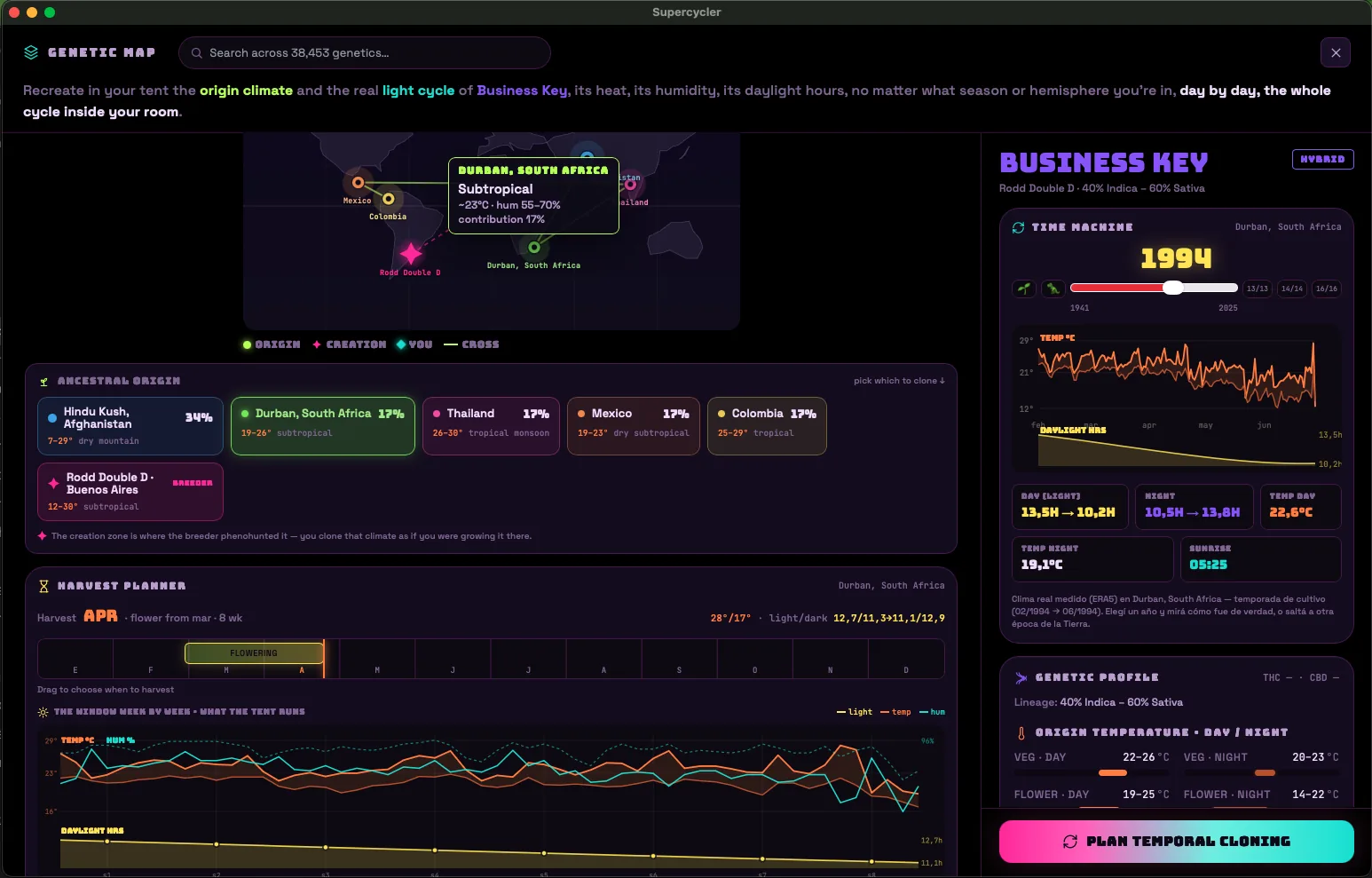
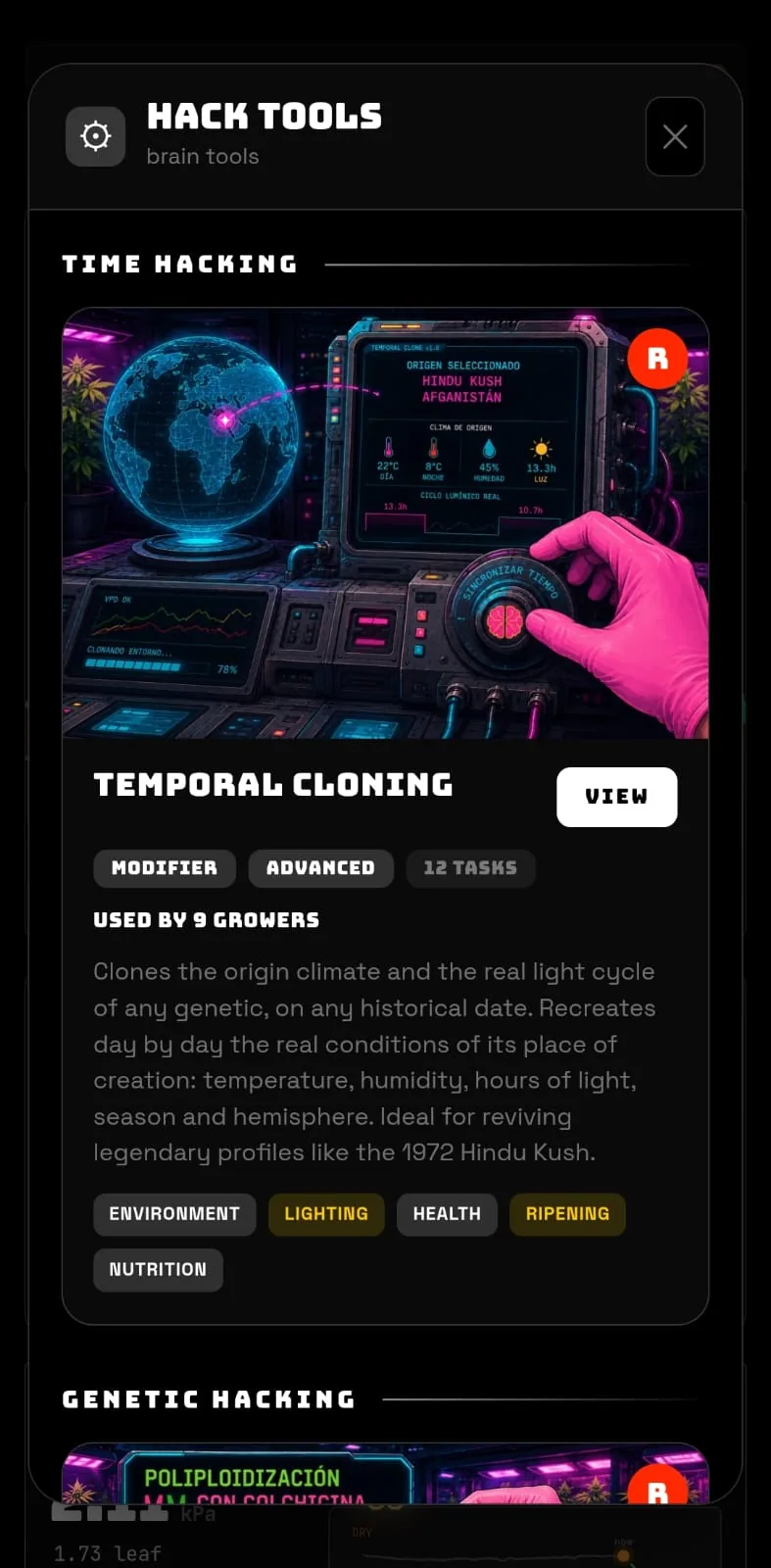
Clone the climate where a genetic found its expression: look up the plant, find its roots, go back to the right year and reproduce its light, its temperature and its humidity inside your room.
An exact cycle of 12 hours of light and 12 of darkness can happen at specific times and places, above all near the equator or the equinoxes. But it is not the universal rule outdoors: at most latitudes the day changes with the season, sometimes slowly, sometimes drastically.
Outdoors nothing flips at the push of a button. Light shifts day by day, temperature swings, humidity breathes, sunrise arrives at another hour. Supercycler turns those variations into an indoor protocol.
Every genetic has a geography and every geography has a time. The map separates three layers so you know exactly which climate you are about to clone.
Where the deep lines come from: the landraces holding up the genetic background.
Where the breeder selected and phenohunted it. It is the climate that accompanied the decision.
Where you are going to try to rebuild that context, no matter the season or the hemisphere.
Creation is not just a name. It is a climate, a latitude and a history of selection.
Mendo Dope Farms · Vanilla Kush × It's Mendo Dope
Ancestral origin and creation zone are different layers: the first explains where the line comes from, the second explains under which environmental pressures it was selected.
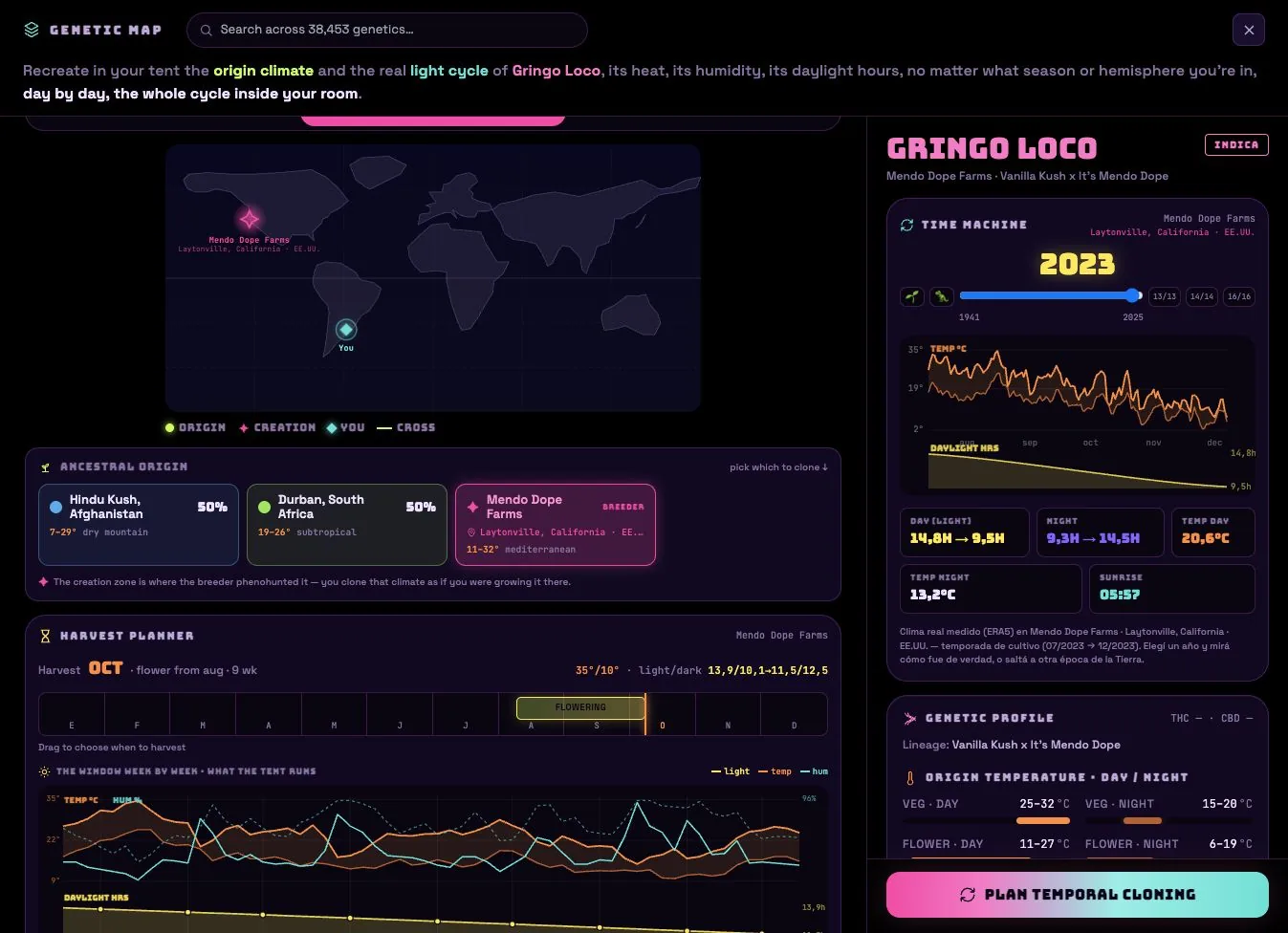
Real screenshot · creation zone selected; the climate panel switches from Hindu Kush to Laytonville without reloading.
Pick the point. Pick the year. See how the place was breathing. The historical climate record of the zone builds the temporal reference of the plan.
13/13 · the supercycle stretches the day to 26 h: the room can travel the arc of the zone without forcing it into a 24 h clock.
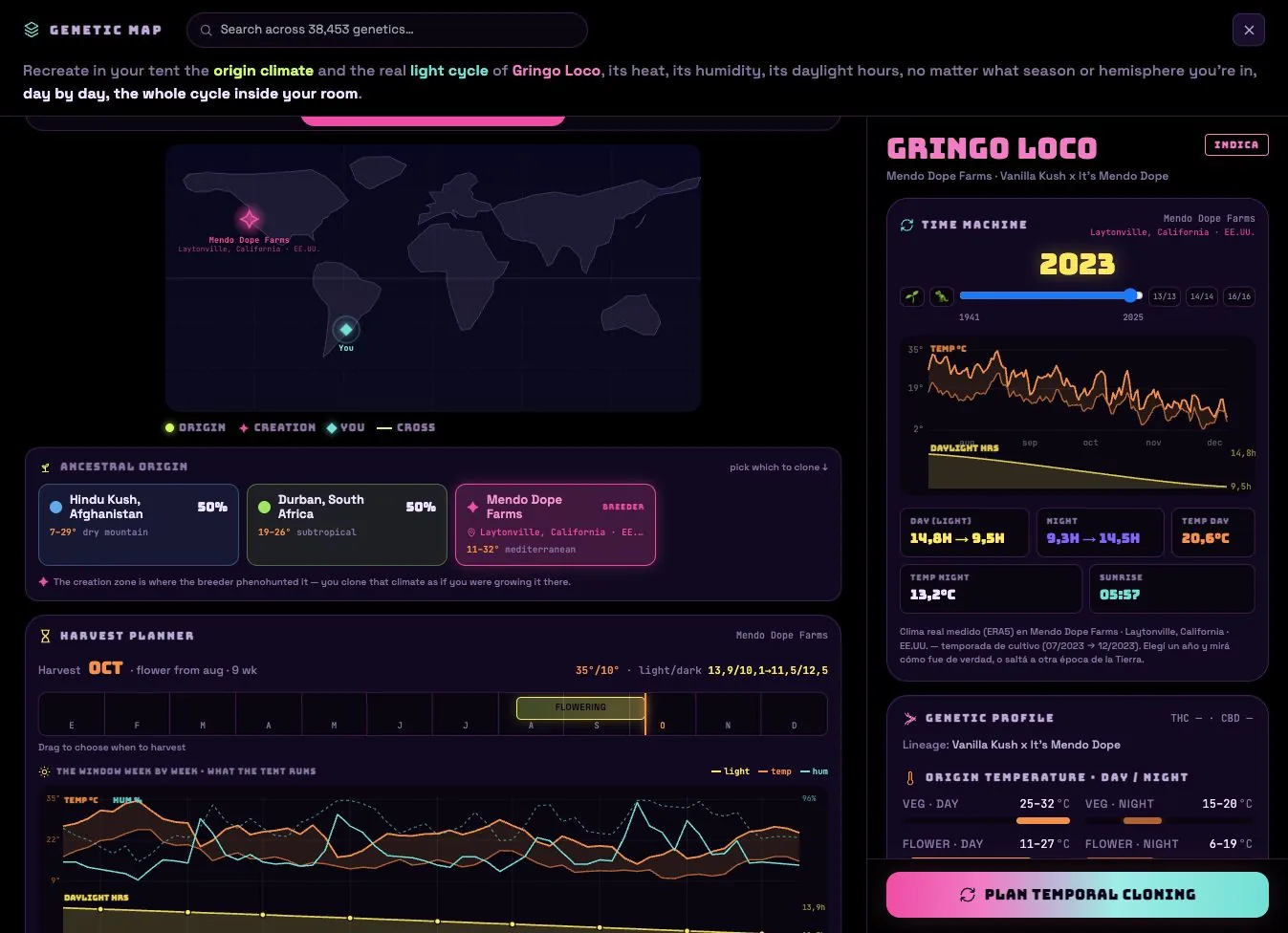
Real screenshot · 1941–2025 slider over the record of the creation zone.
ERA5 is a historical climate reanalysis: it reconstructs how the atmosphere behaved at that place and on that date. It is not a measurement taken plant by plant.
The solar arc and the sunrise are astronomy: they depend on the latitude and the day of the year, not on the year you chose. What changes with the year is the climate.
Moving the harvest window does not change one number: it changes the whole curve. Flowering, light, temperature and humidity are recalculated together.
It is not a fixed recipe: it is a sequence. The values are environmental targets derived from the historical record of the zone, not universal instructions.
The temporal cloning view takes the selected point and generates an indoor protocol starting today: day and night temperature and humidity, VPD, lights on and off, simulated sunrise and a day that shortens on its own.
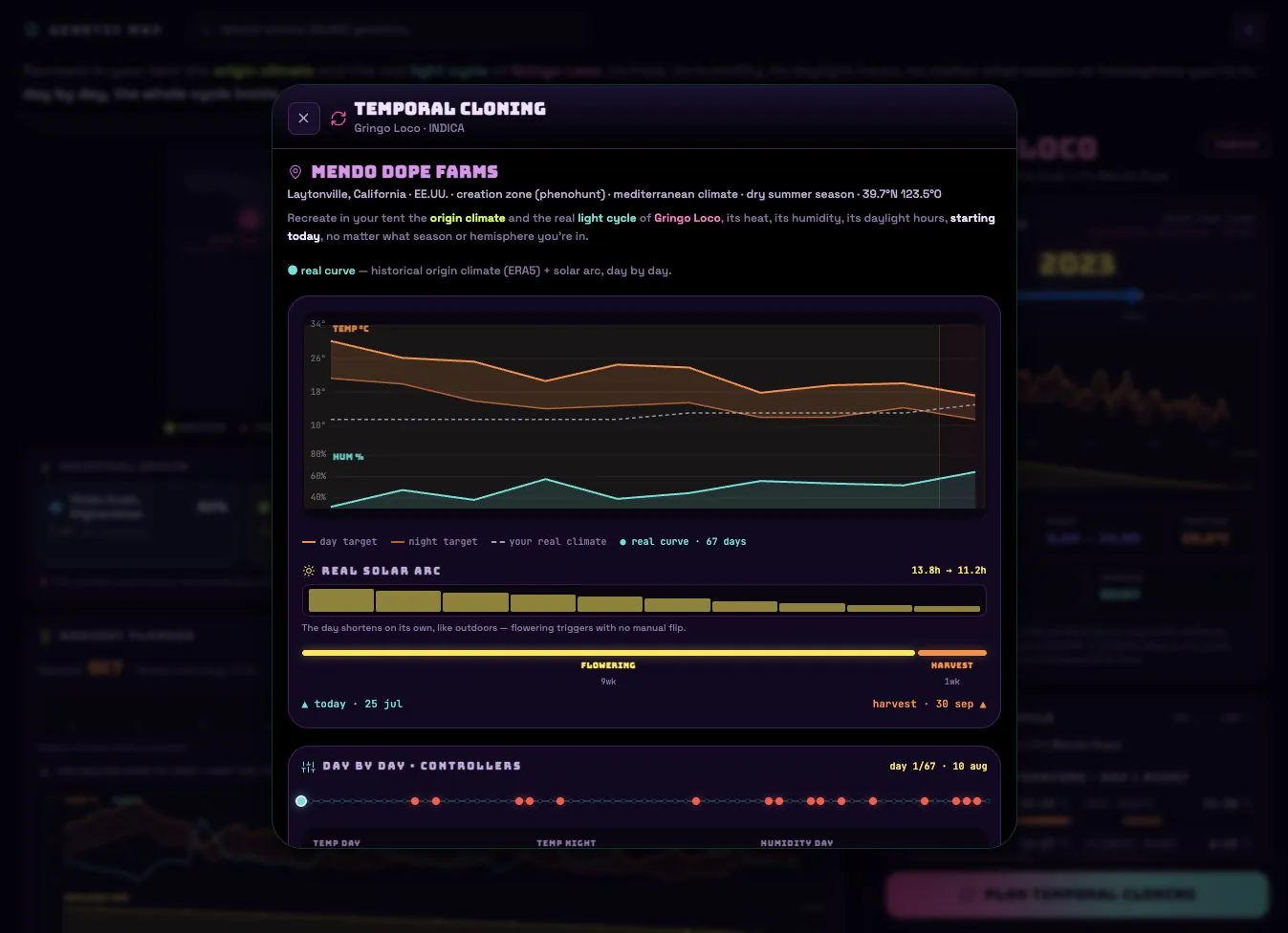
Real screenshot · reversible preview: historical climate + solar arc, day by day.
Example of engine output for a specific genetic and zone. It is not a universal recommendation nor a promise of a result.
The supercycle does not need to pretend that indoor is 12/12. It can make the room travel a light curve close to the one of the place where the genetic was selected.
The preview can smooth climate events with a 3-day moving average to observe a more stable curve. It is a visualisation tool: the applied plan keeps the real record.
Real record · 16 climate events visible across the 67 days of the plan.
| Day 1 | Real record | 3-day moving average |
|---|---|---|
| Day / night temp | 26.5 / 16.8 °C | 26.9 / 17.7 °C |
| Day / night humidity | 38,4 / 70,4 % | 38,0 / 66,9 % |
| Visible events | 16 | smoothed |
We do not hide the difference: smoothing changes what you see, not what happened.
Exploring a climate is free and reversible. Writing it into a zone is a separate decision, explicit and always reversible.
The preview shows the complete plan day by day without writing anything into any zone.
You select the destination by name and confirm with a separate button. If two zones share a name, you check before.
Applying writes light and day/night targets that update themselves every day. It can be reverted whenever you want.
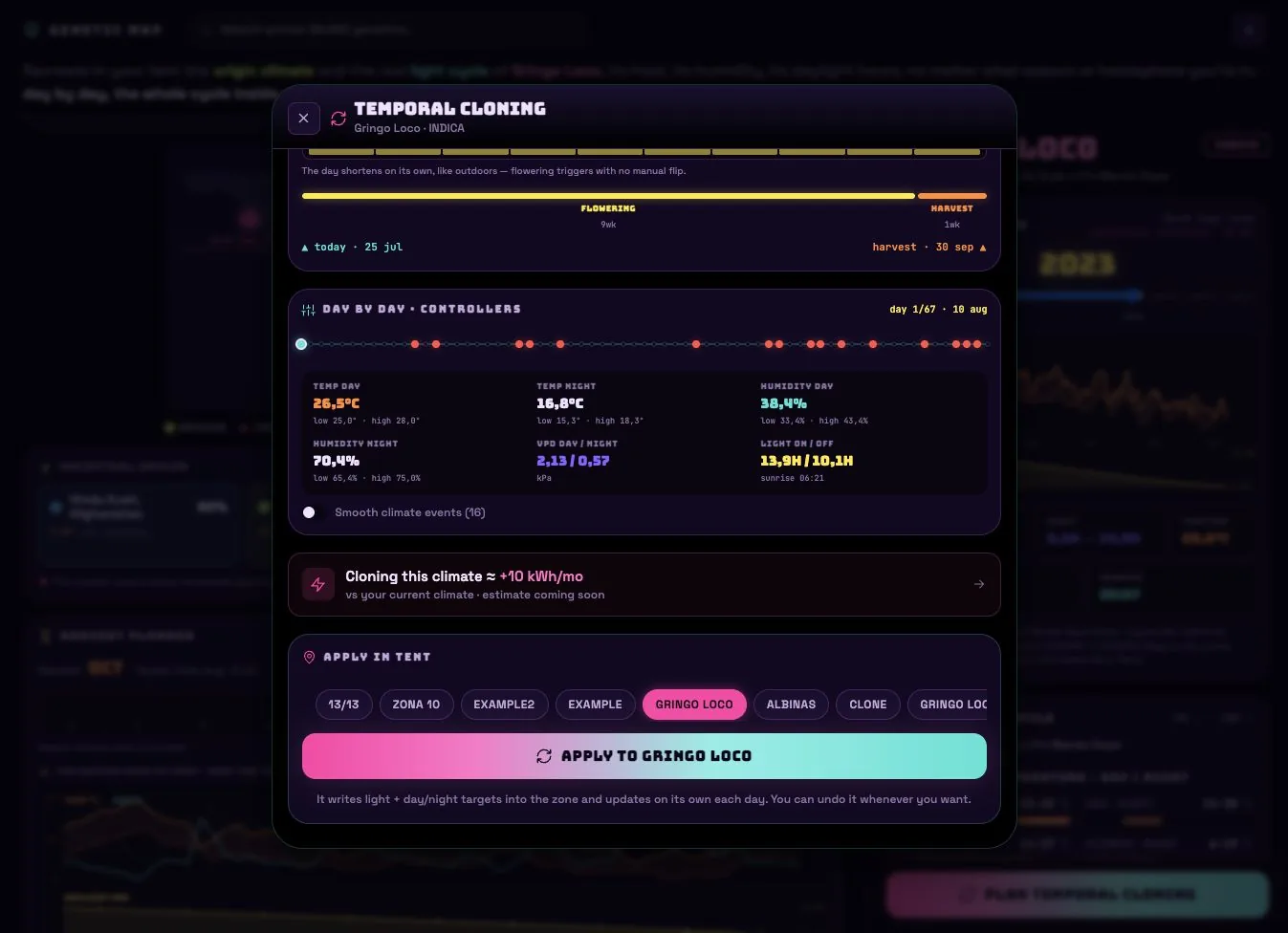
Real screenshot · day 1 metrics and zone selector; the CTA changes to the name of the chosen destination.
Applying writes the light and the day and night targets into the zone, and updates them by itself every day of the cycle. The engine does not promise a phenotype: it recreates environmental pressures associated with a selection.
Hack time. Reproduce the context. Explore the phenotype.
“What happens if I run this strain at 13/13?”
Photoperiod, phases, irrigation, and target climate.
Sensors, cameras, and continuous readings.
The system runs and logs every action.
A traceable report: what you set up, what happened and what you learned.
Our peers are the growers. Brain coordinates a shared protocol so different teams can run comparable experiences. Sensors, photos, notes and real actions come together in traceable reports that other growers can review to confirm, refute or adjust the hypothesis.
Supercycler helps you go from “I want to try something” to research that can be repeated and discussed. The AI supports the process, but human judgment and the community's review stay in control.
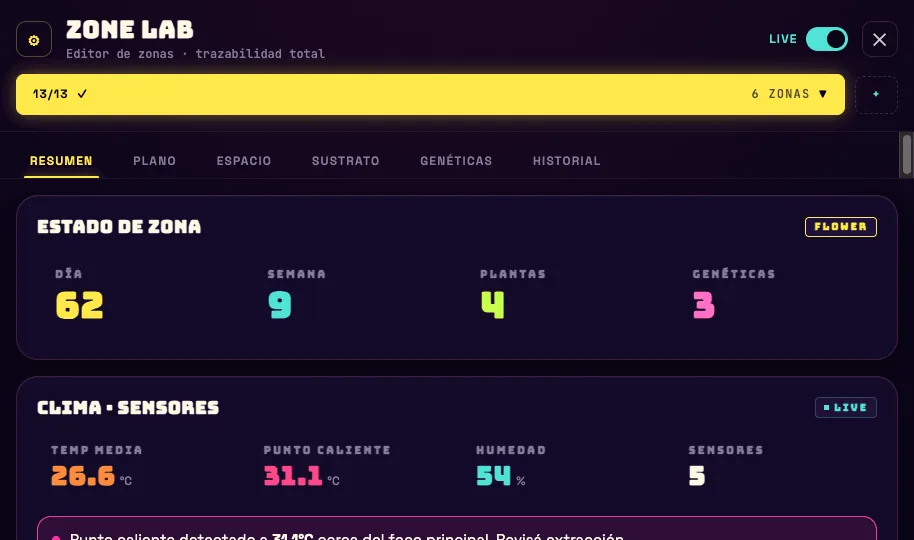
An isolated result is a clue. When several teams run a protocol and review their records, we can tell whether the hypothesis holds, falls apart or needs a different question.
Supercycler is free for up to 4 devices and 2 zones, with every feature active. Enough to automate a real grow, try 13/13, and take part in open research.
Everything you need to run a real Supercycle and be part of the research.
Future paid plans will raise the number of devices and zones. They will not shrink what the free plan can do.
The free plan includes the whole platform. Live sensors, irrigation, climate and light automation, Plant Scan, protocols, and Brain. The limit is scale, meaning 4 devices and 2 zones, not the tools.
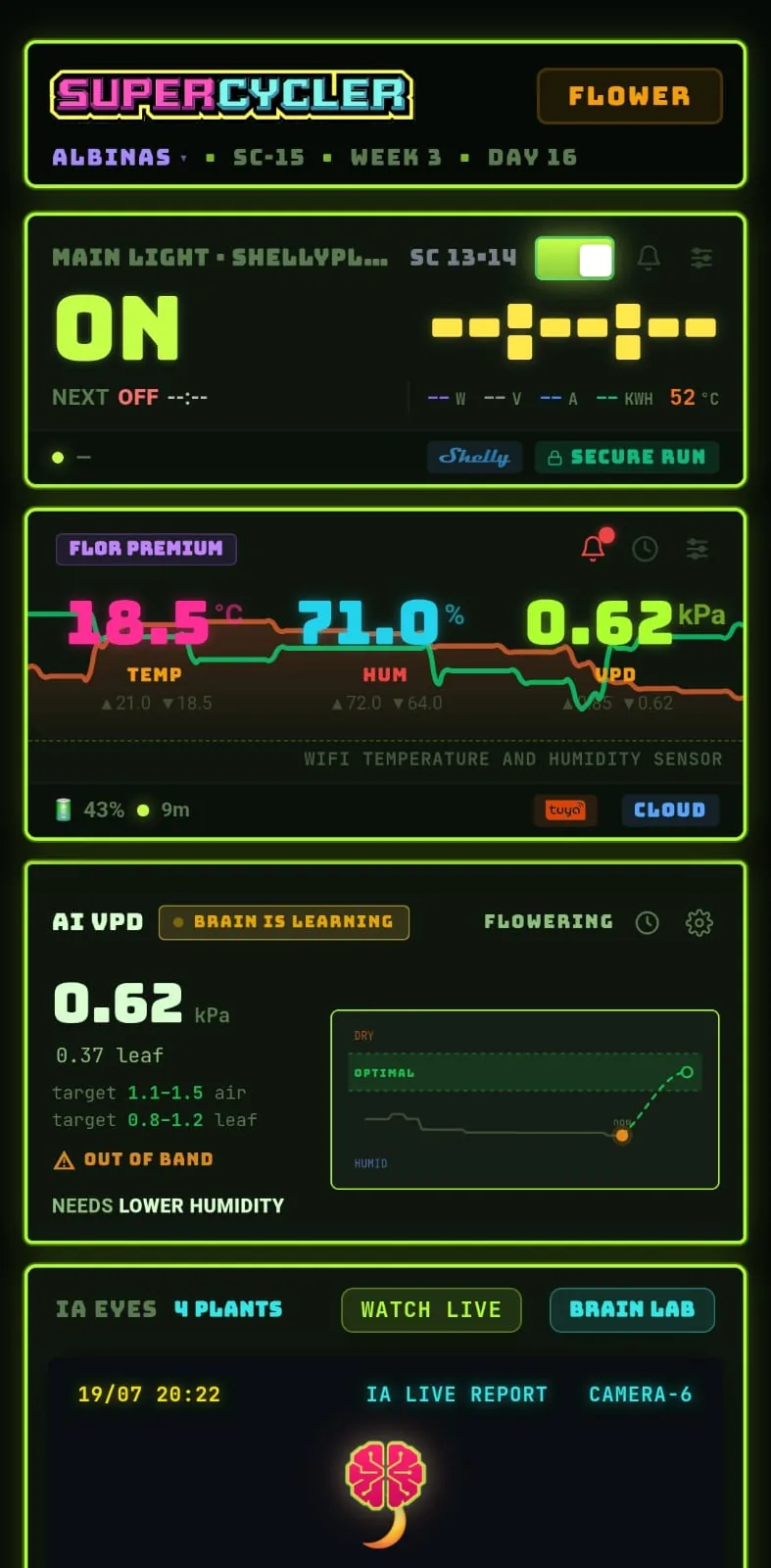
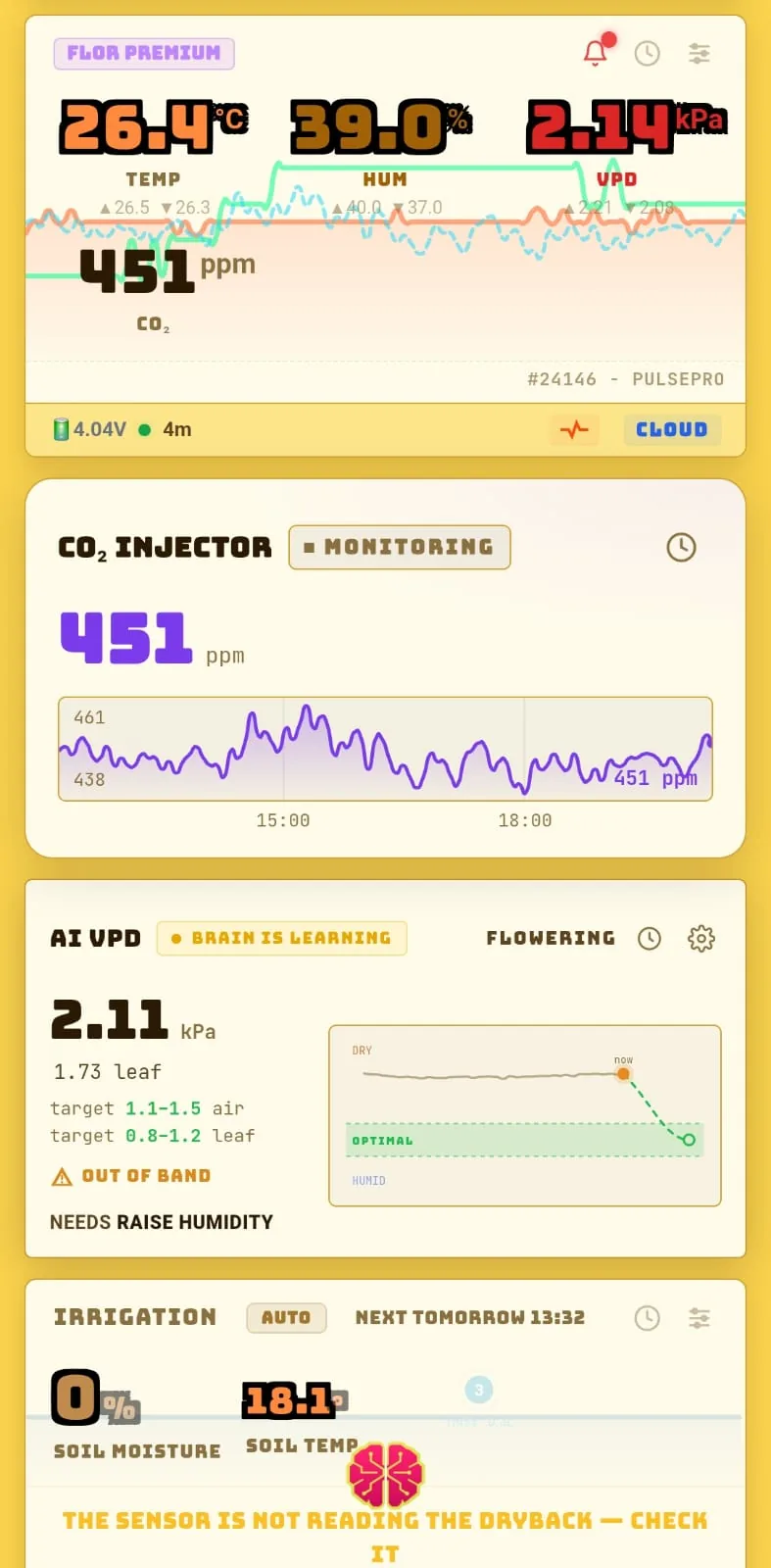
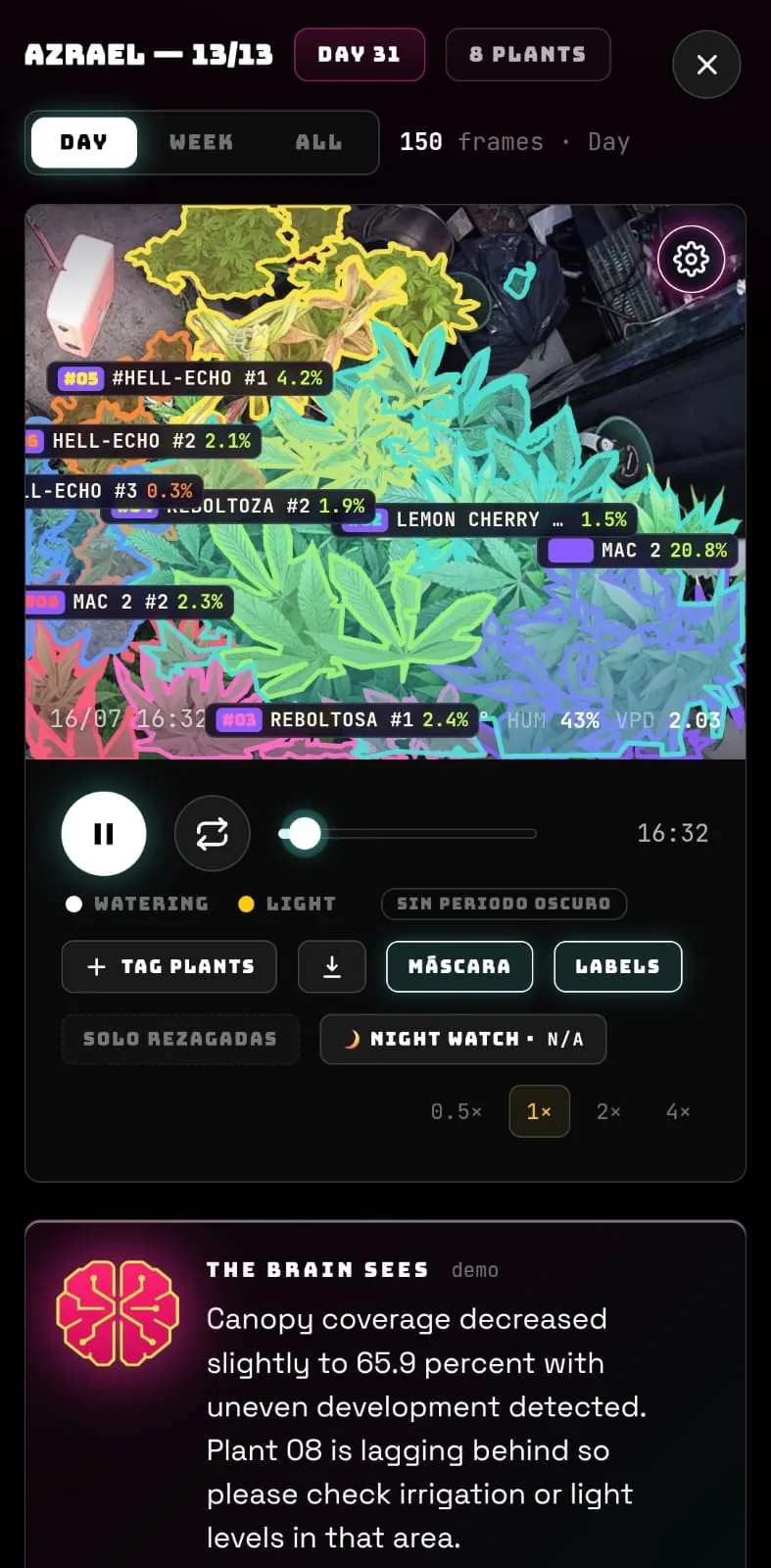
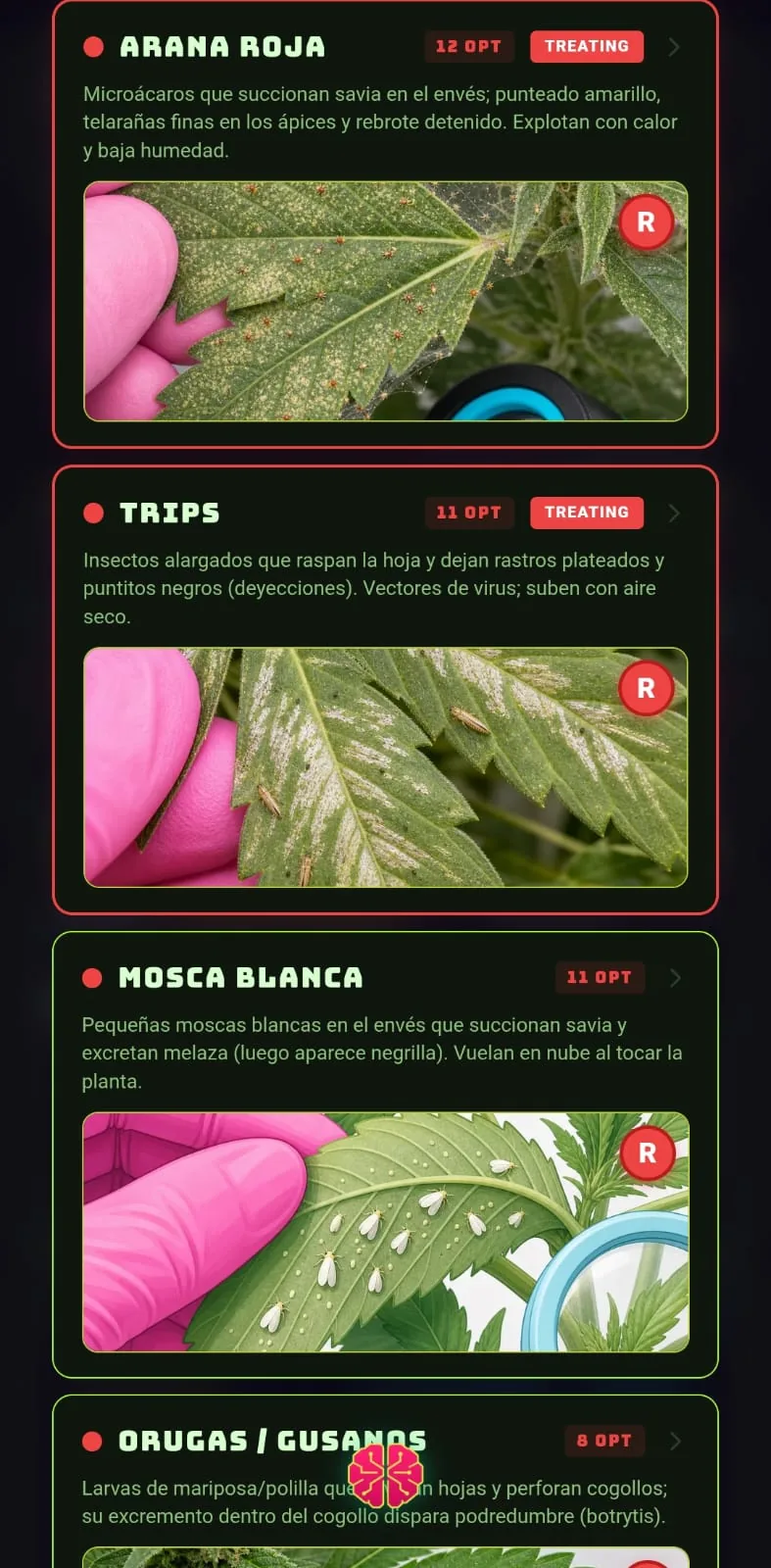
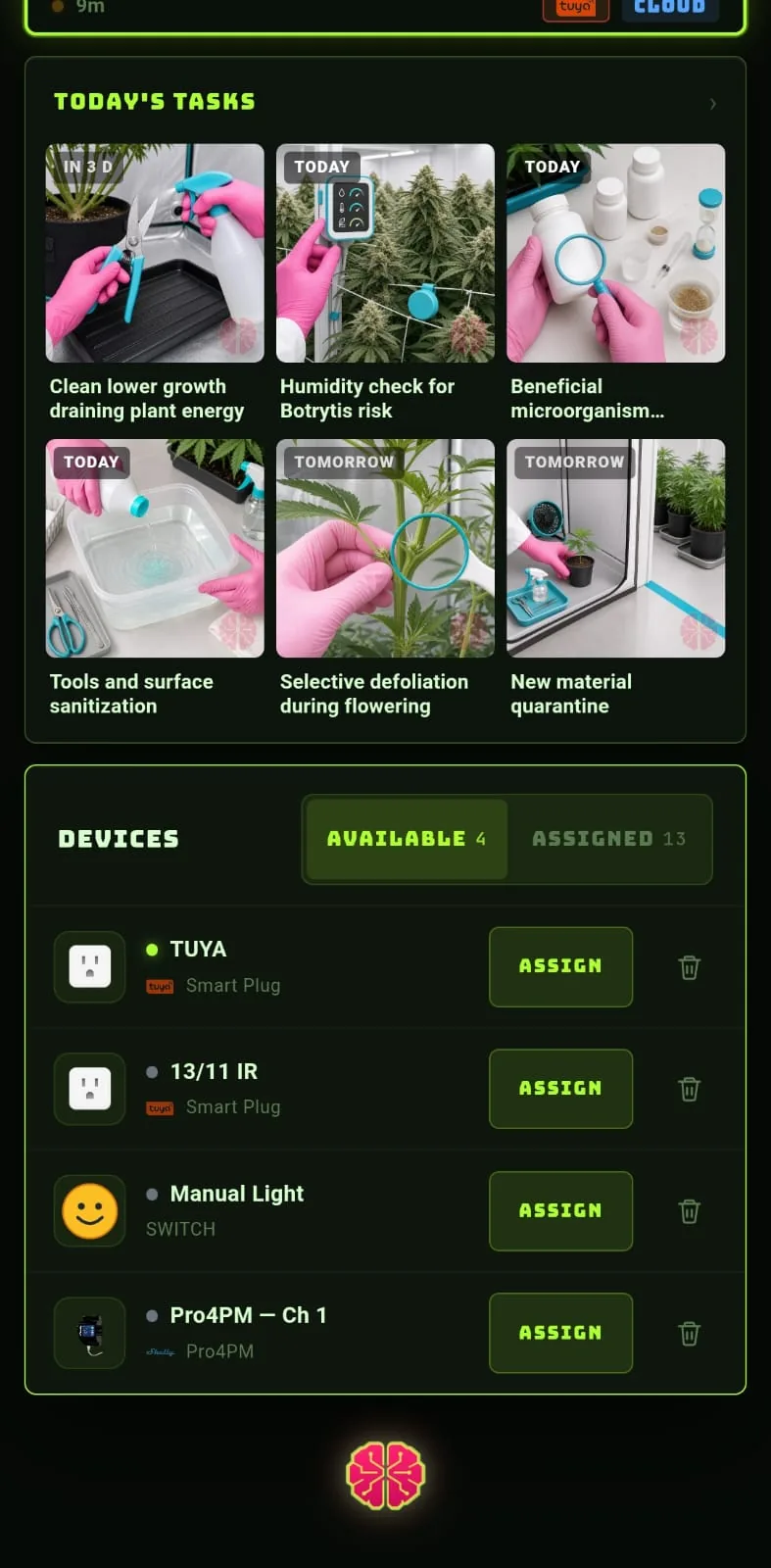
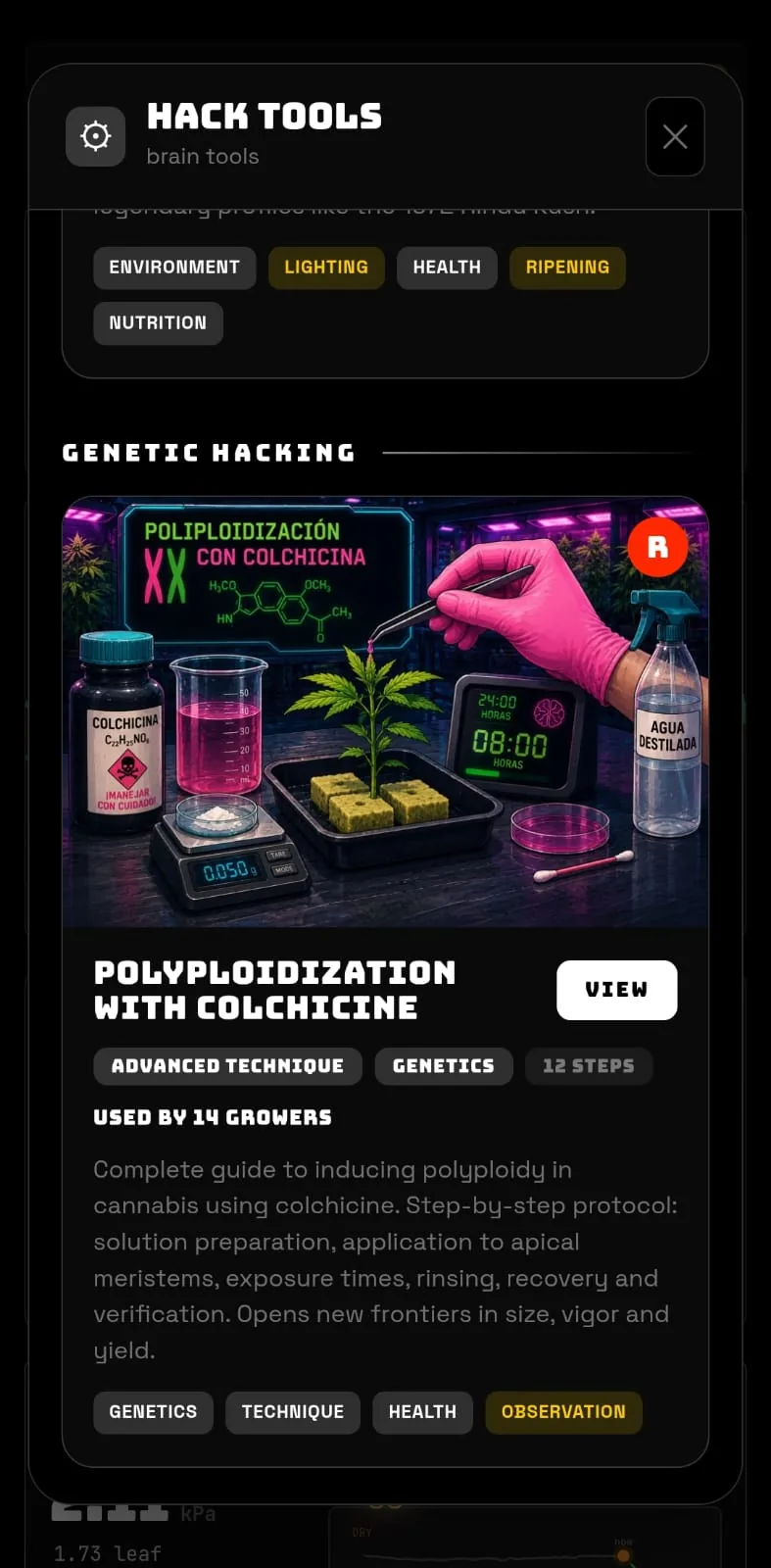
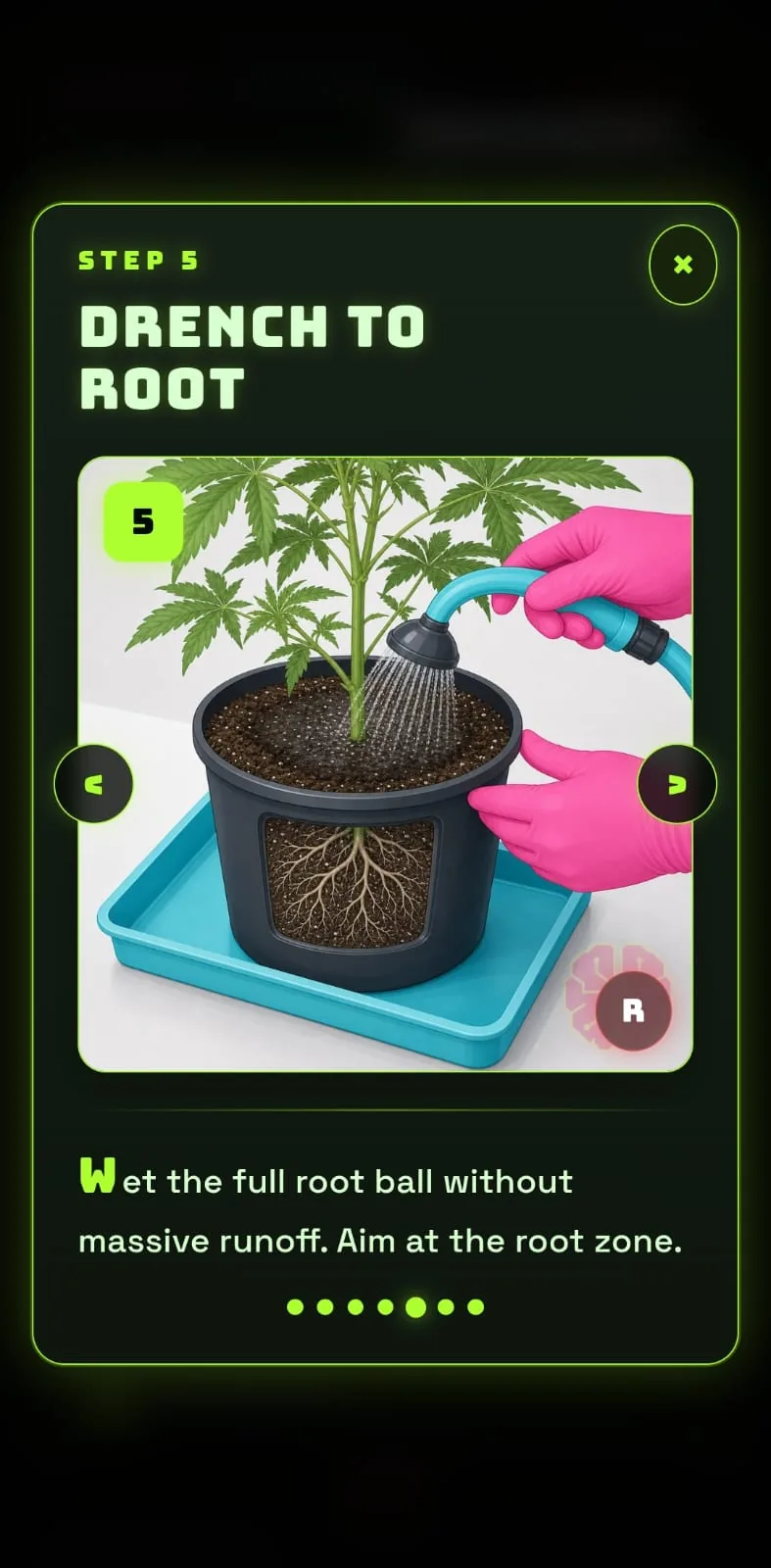
We want as many growers as possible using Supercycler, trying different cycles, and reporting what happens under real conditions. Every report improves the automations, refines the protocols, and builds evidence on Supercycles like 13/13.
Add up to 4 devices and create 2 zones. No card, no locked features.
Design your cycle, automate irrigation, climate, and light, and let the system log everything.
Tell us what worked and what didn't. Your results help improve the platform and the research.
The Supercycles research is public and coordinated from Argentina by members of Team Supercannabis, together with growers contributing data and results from many places. The documentation is shared under a Creative Commons CC BY-NC-SA 4.0 license.
Commercial integrations or uses require authorization and a collaboration agreement.
We publish the methods, hypotheses, and results so the knowledge carries authorship, a date, and public access, and can't later be passed off as a private invention born inside a corporation.
Public research, so collective knowledge doesn't get privatized.
Read the full licenseSupercycler brings the tool. The community brings the grows, the observations, and the reports. The research goes back to everyone. It's open, with authorship and a date.

The free plan covers up to 4 devices and 2 zones with every feature. When you need to connect more equipment or manage more zones, there will be affordable, scalable options. We're still defining them with the community. We don't publish fake prices or charge for features that are part of the full experience today.
Future plans will raise devices and zones without turning core features into add-ons.
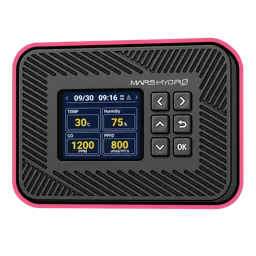
No ecosystem gets to own you. Tuya, Sonoff, Shelly, Zigbee, Pulse, Bluelab, TrolMaster and Mars Hydro live on the same screen and trigger each other: a sensor from one brand can switch on gear from another. You pick price and quality point by point, for whatever your project needs.
Compatibility with a point. Each integration tells you what it can do. Read, act, or alert.


Zigbee
Tuya / SmartLife
Tuya / SmartLife
Shelly
Sonoff
Shelly
Tuya / SmartLife
Tuya / SmartLife
Shelly
Tuya / SmartLife
Sonoff


Tuya / SmartLife
Sonoff
Tuya / SmartLife
Ecowitt
Ecowitt
Tuya / SmartLife
Shelly
SONOFF

PulsePulse ProPulse ZeroPulse One
BluelabGuardian Monitor
TrolMasterHydro-X Pro (HCS-2)Aqua-X Pro
TrolMasterTCS-1 (Tent-X)HCS-1 (Hydro-X)NFS-1 (Aqua-X)
Aqua MasterC800
Purpl ScientificPurpl ProSome community integrations may change while they're being validated with the manufacturer.
TelegramFrom temporary cloning to pest diagnosis, from AI timelapses to the genetic map. This is what growing with Supercycler looks like.
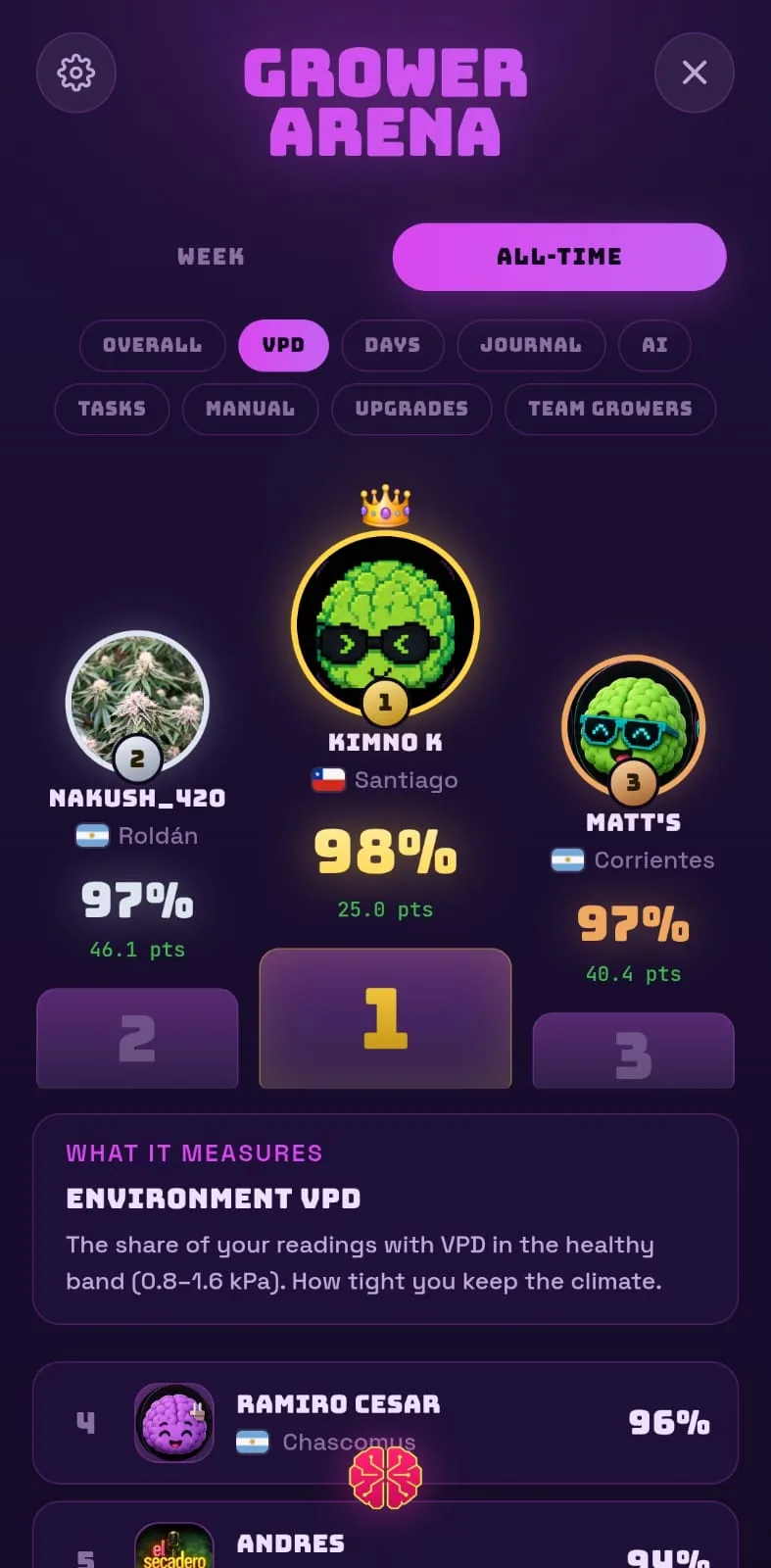
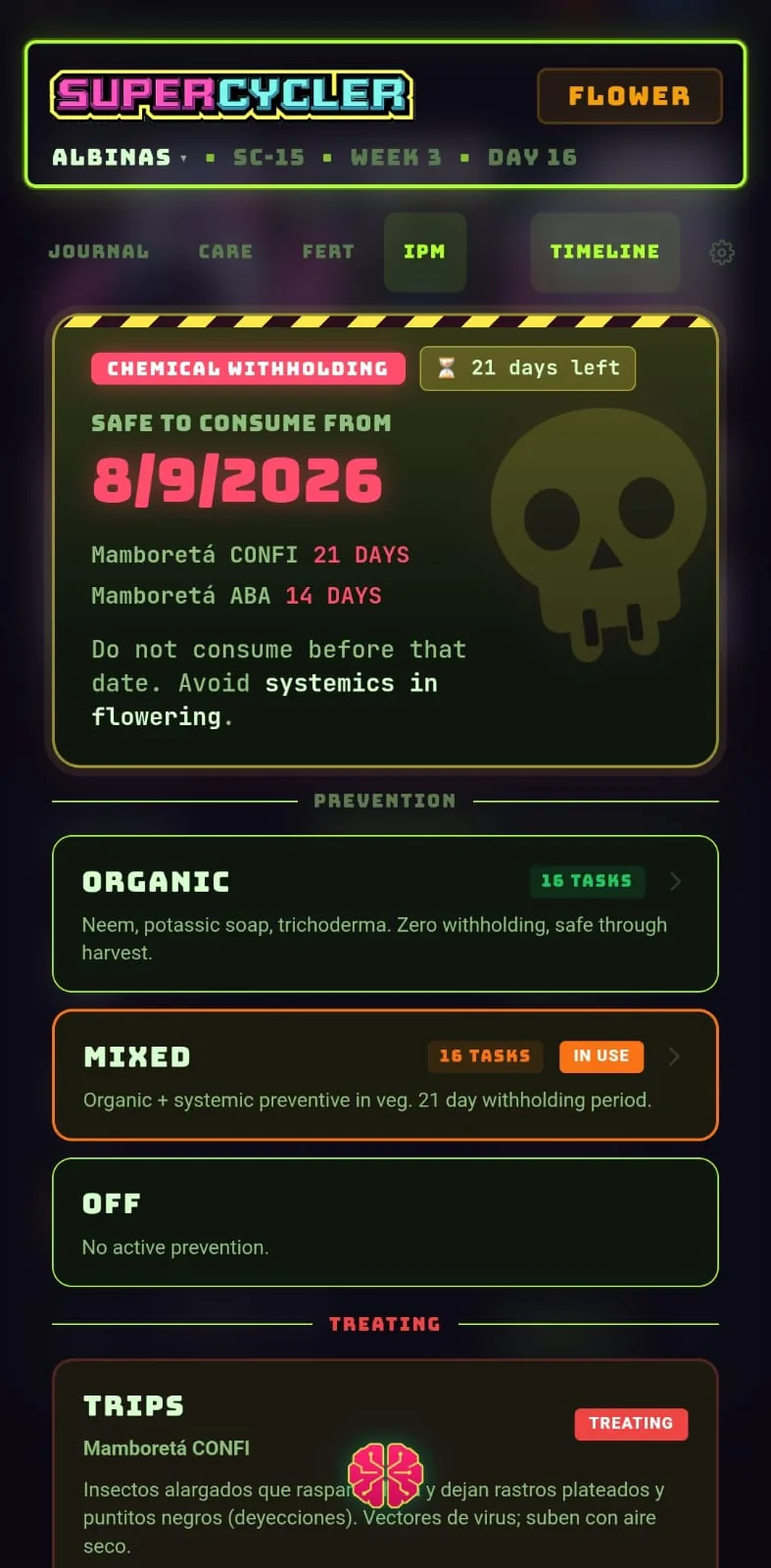


Monitor, decide, and act wherever you are. Android, iOS, and web. In real time, with no reload.
Also runs on the web →
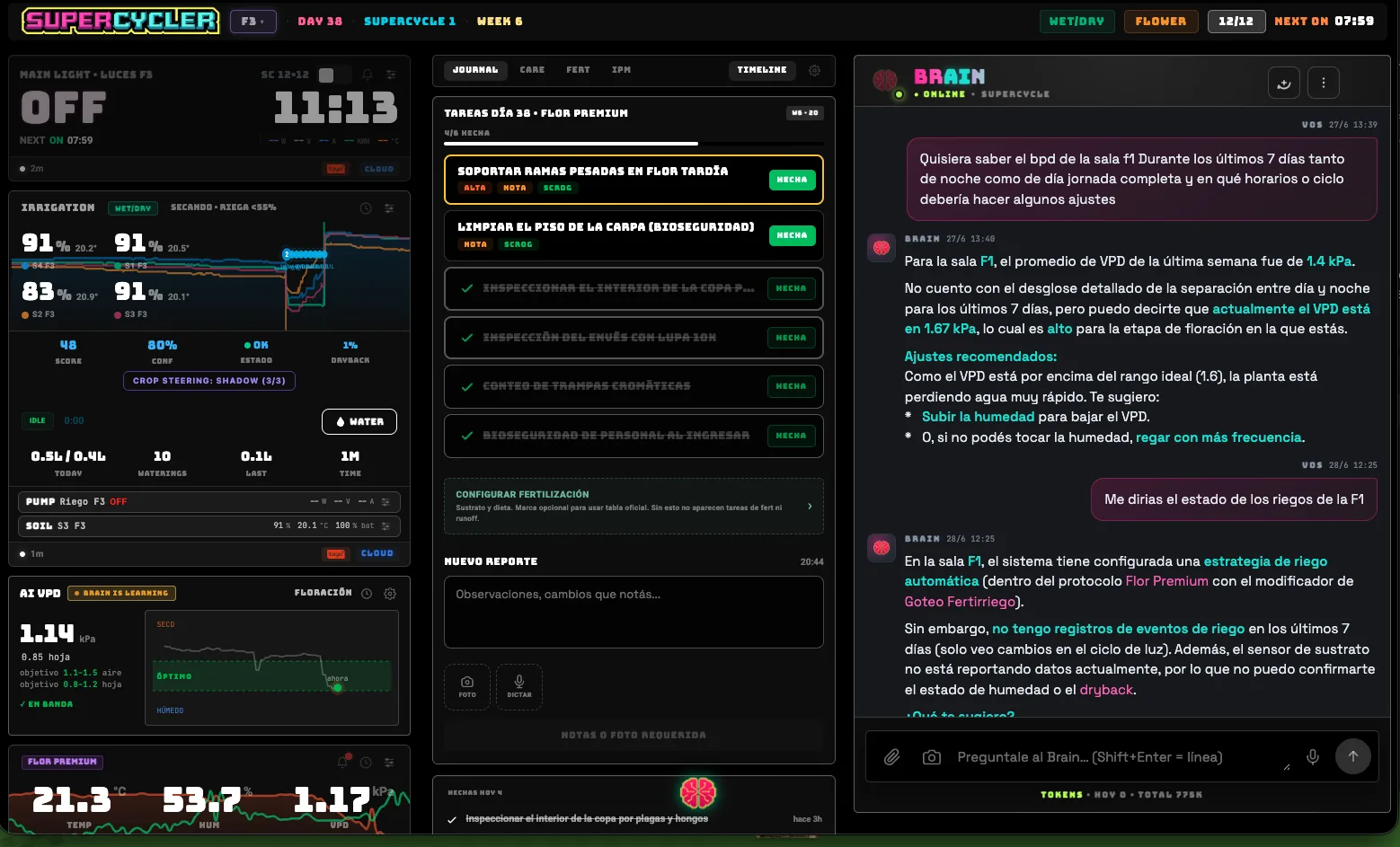

Try 13/13, run a supercycle, or design a hypothesis of your own. Log what happens and add your grow to global research on the future of cannabis. Not everyone has to run the same experiment: we also need controls and unexpected results.